Real estate marketing used to revolve around yard signs, glossy brochures, and Sunday open houses. Those still matter, but the way buyers discover homes has shifted quickly. With nearly all buyers now starting their home search online, agents must stand out where attention lives- on our phones.
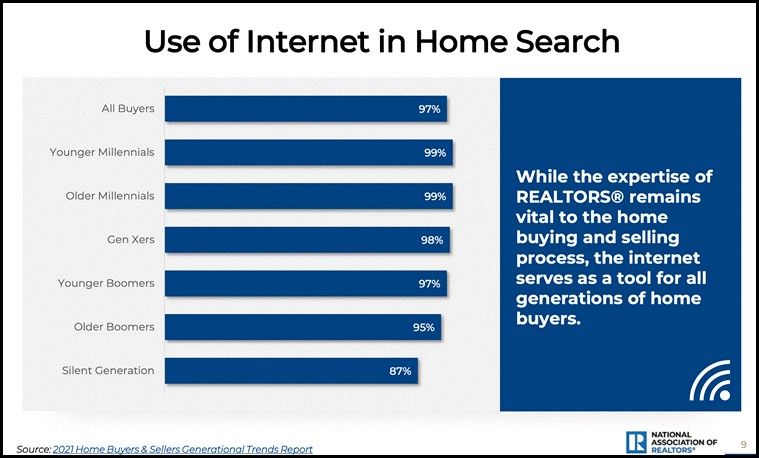
According to the National Association of Realtors, about 97% of homebuyers use the internet in their home search. This makes the digital-first strategies critical for visibility and speed to market.
Image source
Short-form video has moved from “nice to have” to a table-stakes. Instagram Reels, in particular, give agents a quick way to show how a home feels, not just how it photographs.
Video has become the language of modern real estate marketing. Buyers want immersive experiences before they ever set foot in a property. The agents who master visual storytelling are the ones who close deals faster and build stronger client relationships.
As a real estate agent, keep reading to learn how to use Instagram Reels to sell homes.
Understanding Instagram Reels
Reels are short, vertical videos that live across the Instagram ecosystem: your feed, the Reels tab, Explore, and even in hashtag and location pages. They are built for discovery, which means they can reach well beyond your current followers. Yes, buyers look at Instagram accounts for home inspiration.
Each clip can run up to 90 seconds. The in-app editing tools make it easy to stitch together shots, add music, captions, and text, and apply transitions. If you are new to the format, Instagram’s help center breaks down the basics of creating and sharing Reels. Including editing, audio, and publishing options.
What makes Reels different from regular feed videos or Stories?
Instagram Stories connect with people who already follow you and disappear after 24 hours (unless saved as Highlights). Feed videos live on your profile but are not as heavily pushed to new audiences.
On the other hand, Instagram Reels are designed to be recommended and discovered by people who do not yet know you. Instagram has also shared more about work, including what the system prioritizes and what it avoids.
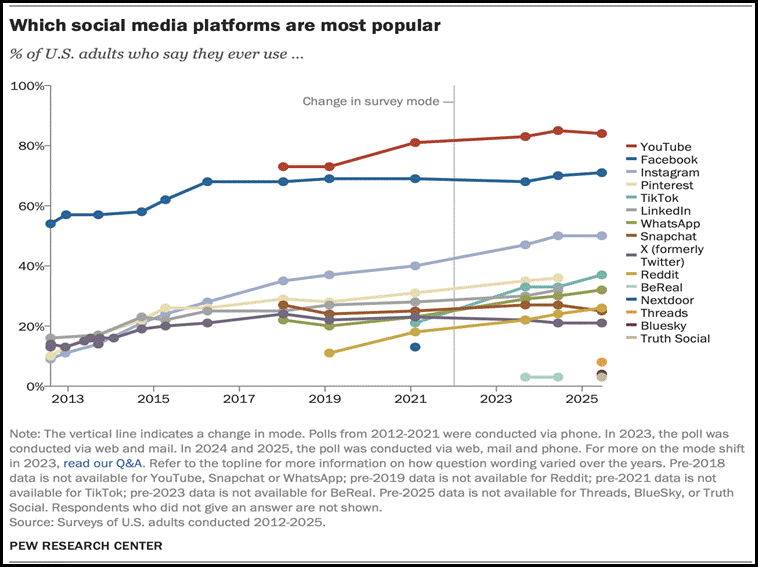
This discovery engine matters because Instagram is still one of the most widely used platforms, especially for younger buyers. Pew Research finds Instagram is a top social app for adults under 30 in the United States with strong usage among those 30–49 as well.
Image source
Why Instagram Reels work for selling homes
Reels grab attention quickly. They also keep people watching. That is why they should be part of your real estate marketing materials.
Meta has noted that pushing Reels and improving its AI recommendations increased time spent on Instagram by about 24% after launch. This points to how compelling short-form video has become.
For real estate, the format shines because homes are best understood in motion. The way light moves through a kitchen at 8 a.m., or how the hallway opens into a big, bright living space. That is why it is best to use videos to sell your house.
Adrian Iorga, Founder and President of Stairhopper Movers, emphasizes how powerful that sense of movement is in shaping perception. With relocation being such a high-consideration, emotional decision for buyers, visual clarity plays a key role in how quickly they connect with a space.
Iorga says, “When people experience a home through video, they are not just seeing rooms…they are mentally moving through the space. That sense of flow and liveability helps buyers instantly understand how a home would fit into their everyday lives- something static photos simply cannot replicate.”
Reels also build personal brand trust. When buyers see and hear you narrate features and share neighborhood insights, you become more than a name on a sign. You become the guide they want, walking them through a big decision.
How To Create Real Estate Reels That Work
Key steps for creating Reels
You do not need a production studio. You need a plan and a steady hand. Even a good eye for moments that tell a story.
- Start with a hook. Lead with the home’s strongest moment in the first two seconds. A dramatic view, a sweeping staircase, a cozy reading nook, or the backyard reveal.
- Map a mini story. Think in beats. Curb appeal, entryway, living space, kitchen, primary suite, outdoor area, and a final call to action (CTA). Keep clips short and let the movement do the work.
- Shoot vertically and keep it steady. Use 9:16 framing. A smartphone gimbal helps. However, slow, deliberate camera movement goes a long way.
- Chase great light. Morning or late afternoon light flatters interiors. Turn on all lights and open blinds. Then, watch for harsh shadows.
- Compose for depth. Move from wide to medium to detail shots. A tight shot on hardware or a window latch can make luxury feel tangible.
- Narrate with intention. Add on-screen text and/or voiceover to guide viewers. Speak to benefits (flow, storage, commute, school proximity) rather than just features.
- Caption everything. Many viewers watch without sound. Auto-captions increase accessibility and watch time.
- Optimize discoverability. Add location tags and relevant hashtags (even a clear CTA). Instagram’s own guidance on ranking and recommendations can help you align content with what the system favors.
- Batch your work. Film multiple Reels in one visit (interiors, exteriors, neighborhood b-roll), so you have content for fresh posts all week.
What works: real estate Reels in action
There is no denying the use of social media for real estate agents. Across the globe, agents are specifically proving that short, thoughtful videos help listings move.
We have seen 20–30-second Reels that pair a morning kitchen shot with a quick walk-through outperform static posts by a mile. The common thread? They tell a clear story and invite the next step.
Wade O’Shea, Founder of BusCharter.com.au, highlights how consistent storytelling through short-form video is reshaping how listings perform.
With experience in coordinating group transport and managing complex movement logistics, he understands how clarity of flow and spatial experience influence decision-making. This translates into how buyers interpret property walkthroughs online.
O’Shea explains, “Short-form video helps buyers quickly understand how a space feels to move through…not just how it looks. In real estate marketing, that clarity can make the difference between passive viewing and genuine buyer interest.”
A few patterns show up in Reels that perform well:
- They lead with a wow moment, not a logo.
- They anchor the video in one theme (natural light, entertaining spaces, walkability), so the piece feels focused.
- They include hyper-local context (a Saturday farmers’ market clip, the coffee shop patio at golden hour, a nearby dog-friendly trail).
Best practices and ethical guidelines
Great marketing never bends the truth. Real estate advertising carries extra responsibility because the decisions it drives are expensive and emotional.
Keep these guidelines in mind:
- Be accurate. Do not overstate square footage or condition. If a shot includes digital staging, say so in the caption.
- Respect Fair Housing. Avoid language that implies preference or limitation for protected classes. Review the Fair Housing Act and your brokerage policies.
- Mind music rights. Use Instagram’s approved music options for business use, like the Commercial Music Library.
- Get permissions. Do not show people, personal photos, mail, or license plates without consent. Secure photo/video access in your listing agreements.
- Disclose brokerage and license details. Follow your state’s advertising rules and the National Association of Realtors (NAR) Code of Ethics for accuracy and identification.
- Keep it current. If a property status changes, update or remove posts to avoid misleading potential buyers.
Future Trends: What is coming next
It is abundantly clear: As a real estate agent, you have to use social media to sell homes.
Short-form video is not a fad. It is a format shift. Expect more robust analytics and improved editing tools. Look forward to deeper integration with lead forms and messaging.
As AI-driven recommendations continue to evolve, the system will get better at matching your content with the right buyers. This is exactly what agents need: qualified eyeballs, not just big numbers.
Conrad Wang, Managing Director of EnableU, focuses on how digital systems are reshaping how professionals reach and convert audiences. He sees short-form video becoming increasingly data-driven. Where performance insights will matter just as much as creative execution.
Wang notes, “The next stage of real estate marketing will be defined by how well agents combine storytelling with data. Those who understand both the creative and analytical side of video will be best positioned to consistently reach serious, high-intent buyers.”
A few moves that will pay off:
- Work on your on-camera presence and voiceover skills. Be short, clear, and human.
- Build a content library of neighborhood b-roll you can reuse across listings.
- Treat Reels like a listing asset. Include them in your marketing plan and timeline, just like photography and copy.
- Maintain a professional business line on your cell to manage client communications and inquiries.
Track what viewers replay or watch through. Those are your money shots.
Final Thoughts
Instagram Reels help agents move faster. How? They meet buyers where they already spend time and bring listings to life in a way photos cannot. They are quick to make and powerful to share.
If you have been on the fence, start small. Film the front door swing, the kitchen reveal, the sunset on the patio. Add a line of text and a gentle call to action. Then post again tomorrow.
Simple, honest storytelling wins. Reels give you the canvas. Your listings provide the story. Now’s the time to hit record!
Author’s Bio: Brooke Webber is a passionate advocate for a people-first strategy in HR. Her major focus areas are workplace psychology and employee listening, where she has already accumulated five years of writing experience.
At work, Brooke follows Benjamin Franklin’s principle: “Either write something worth reading or do something worth writing.”
In life, she is an absolute bookworm, reading anything and everything, and a coffee addict who cannot start a day without a good brew.
Continue reading →