Realty Executives Midwest
Summer is the perfect time to enjoy backyard barbecues, gardening, evenings on the patio, and outdoor family activities. Unfortunately, warmer temperatures also bring mosquitoes, flies, ants, wasps, and other unwanted pests that can quickly put a damper on outdoor fun.
The good news is that keeping summer pests under control doesn’t always require harsh chemicals. With a combination of preventative maintenance, strategic landscaping, and natural repellents, homeowners can create a more comfortable outdoor environment while minimizing the impact on people, pets, and beneficial pollinators.
One of the most effective ways to reduce mosquito populations is to eliminate standing water around your property. Mosquitoes can lay eggs in surprisingly small amounts of water, making even minor sources a potential breeding ground.
Regularly inspect your property for:
Refreshing bird bath water every few days and ensuring proper drainage throughout your yard can significantly reduce mosquito activity.

Certain plants are known for their natural insect-repelling properties and can be attractive additions to patios, gardens, and outdoor living spaces.
Popular options include:
While these plants won’t eliminate insects entirely, they can help discourage some pests while adding beauty and fragrance to your outdoor spaces.
As an added benefit, many of these herbs can also be used in summer recipes and beverages.
Pests thrive in areas where they can hide, nest, and access moisture. Maintaining your landscape can make your property less inviting to unwanted visitors.
Simple steps include:
A tidy yard not only helps reduce pests but also improves curb appeal and creates a more enjoyable outdoor environment.
Seal Entry Points Around Your Home
Summer pests don’t just stay outside. Ants, spiders, flies, and other insects often find their way indoors through small gaps and openings.
Take time to inspect:
Replacing damaged screens and sealing openings can help keep insects outside where they belong.
For homeowners who prefer alternatives to traditional chemical insecticides, there are several natural options available.
Many natural bug sprays use plant-based ingredients such as:
These products are often used to repel mosquitoes and other common insects around patios, decks, and outdoor seating areas.

When shopping for natural repellents, look for products specifically labeled for outdoor pest control and follow all manufacturer instructions. Some sprays are designed for personal use on skin or clothing, while others are formulated for treating outdoor areas and landscaping.
It’s important to remember that natural repellents may require more frequent application than conventional products, especially after rain or extended outdoor use.
Outdoor entertaining areas often become gathering places for both guests and insects.
To help keep bugs at bay:
Many flying insects struggle in moving air, making outdoor fans a surprisingly effective addition to patios and decks.
Not all insects belong on the “unwanted” list. Many species play important roles in maintaining a healthy ecosystem.
Birds, dragonflies, and certain beneficial insects naturally feed on mosquitoes and other pests. Creating a balanced landscape with native plants can help attract these helpful visitors while supporting local biodiversity.
The goal isn’t to eliminate all insects—it’s to create a healthier outdoor environment where pest populations remain manageable.
Summer should be a time for relaxing outdoors, not constantly swatting away insects. By eliminating standing water, maintaining your landscape, sealing entry points, and using natural repellents when needed, you can create a more comfortable outdoor space without relying heavily on harsh chemicals.
Small preventative measures often make the biggest difference. A few simple habits can help keep summer pests under control while allowing you to enjoy everything the season has to offer—from backyard gatherings to peaceful evenings on the patio.
Source: Realty Executives
Realty Executives Midwest
1310 Plainfield Rd. Ste 2 | Darien, IL 60561
Office: 630-969-8880
E-Mail: experts@realtyexecutives.com

A lot of people who want to move are telling themselves the same thing: “Maybe I’ll just wait until later this year once things calm down.”
While waiting sounds like a good plan, there’s something worth knowing before you decide. Rates aren’t expected to change much, so if that’s the #1 reason you’re waiting, it may not pay off. And there may be other things you miss out on in the meantime.
Historically, Summer is one of the strongest seasons of the year for both buyers and sellers. And if you delay your move until Fall or Winter, some of those opportunities may already be fading.
One of the biggest frustrations buyers have faced over the past few years has been a lack of affordable options. Maybe you’ve run into that yourself:
You find a house you like, but it’s out of your budget.
You find something in your budget, but you don’t like it.
Or worse, nothing interesting hits the market for weeks.
Historically, Summer helps with that.
Looking at data from the last few years, Summer months consistently bring more sellers into the market than later in the year. And that gives buyers a real window of fresh choices.
According to Realtor.com, any given Summer month typically sees about 32% more fresh options than the average month from September-December.
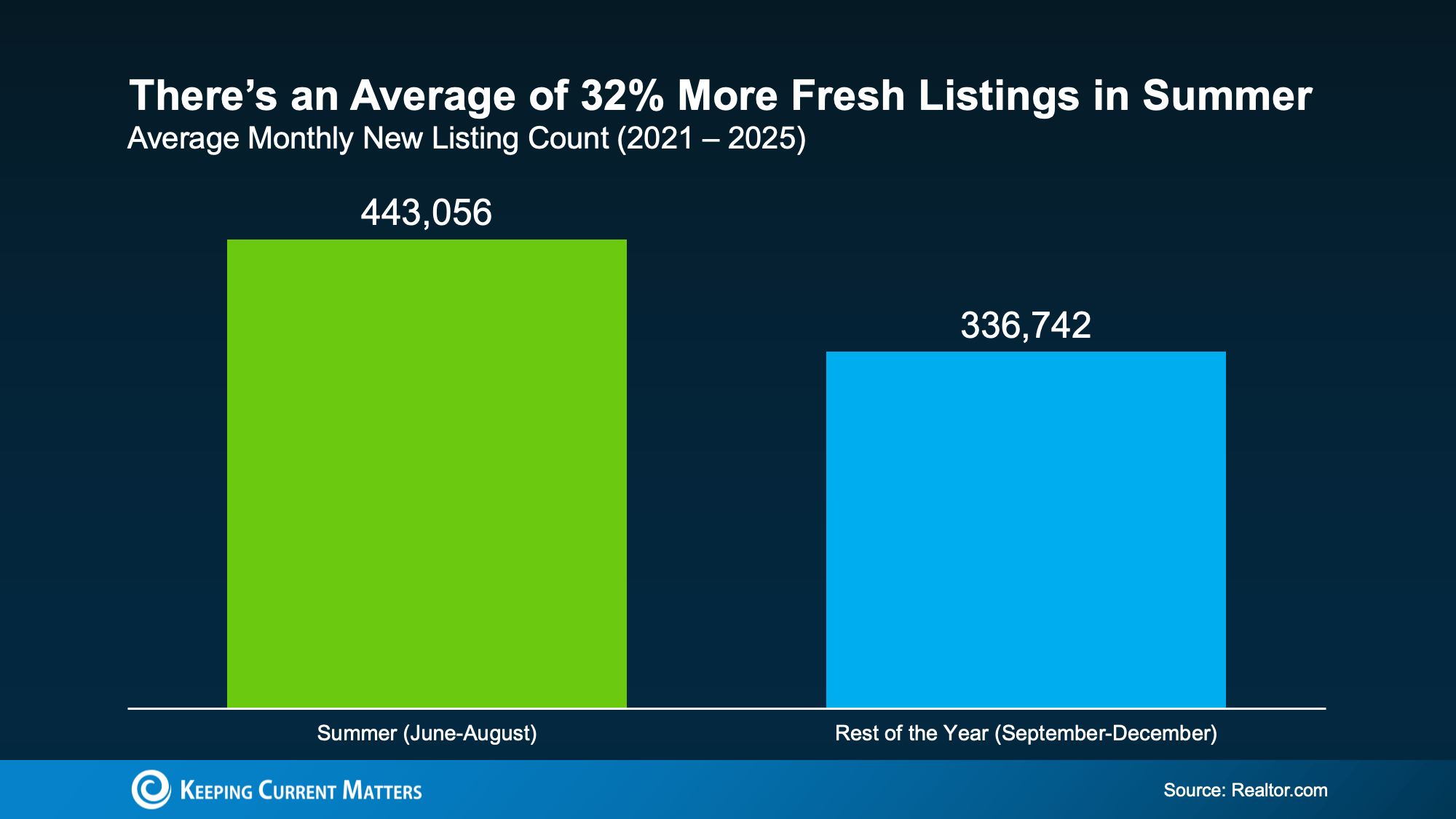
With more newly listed homes, there’s a better chance of finding one you like where the numbers actually work.
Because all it really takes is one home to completely change your search. And if you’ve got more popping onto the market to choose from, maybe one of those is exactly what you need.
But keep in mind, this seasonal window isn’t open forever. Fresh inventory tends to slow down once Summer ends.
Many homeowners who planned to sell this year have already listed by then. Families who wanted to move before school starts have often already gotten it done, or at least, set it into motion. So, new listing activity usually cools as we head into Fall and Winter.
Of course, every year is different. But if finding the right home at the right price has been your biggest challenge, waiting until later in the year may not necessarily give you more options. In fact, recent history suggests it may do just the opposite.
If you’re thinking of selling, you may be considering holding off because you’ve seen headlines about lower asking prices, price cuts, and softer conditions in some markets. But those headlines don’t tell the whole story or convey just how much it varies by area.
Here’s what you really need to know. Even though the market’s becoming more balanced and some pockets are experiencing price declines, that doesn’t mean you’ve missed your chance to sell.
Seasonality can still work in your favor no matter where you are. And this Summer could still give you the chance to sell for a good price.
According to the National Association of Realtors (NAR), homes sold during a Summer month usually sell for about 4% more than homes sold during the typical month from September-December:
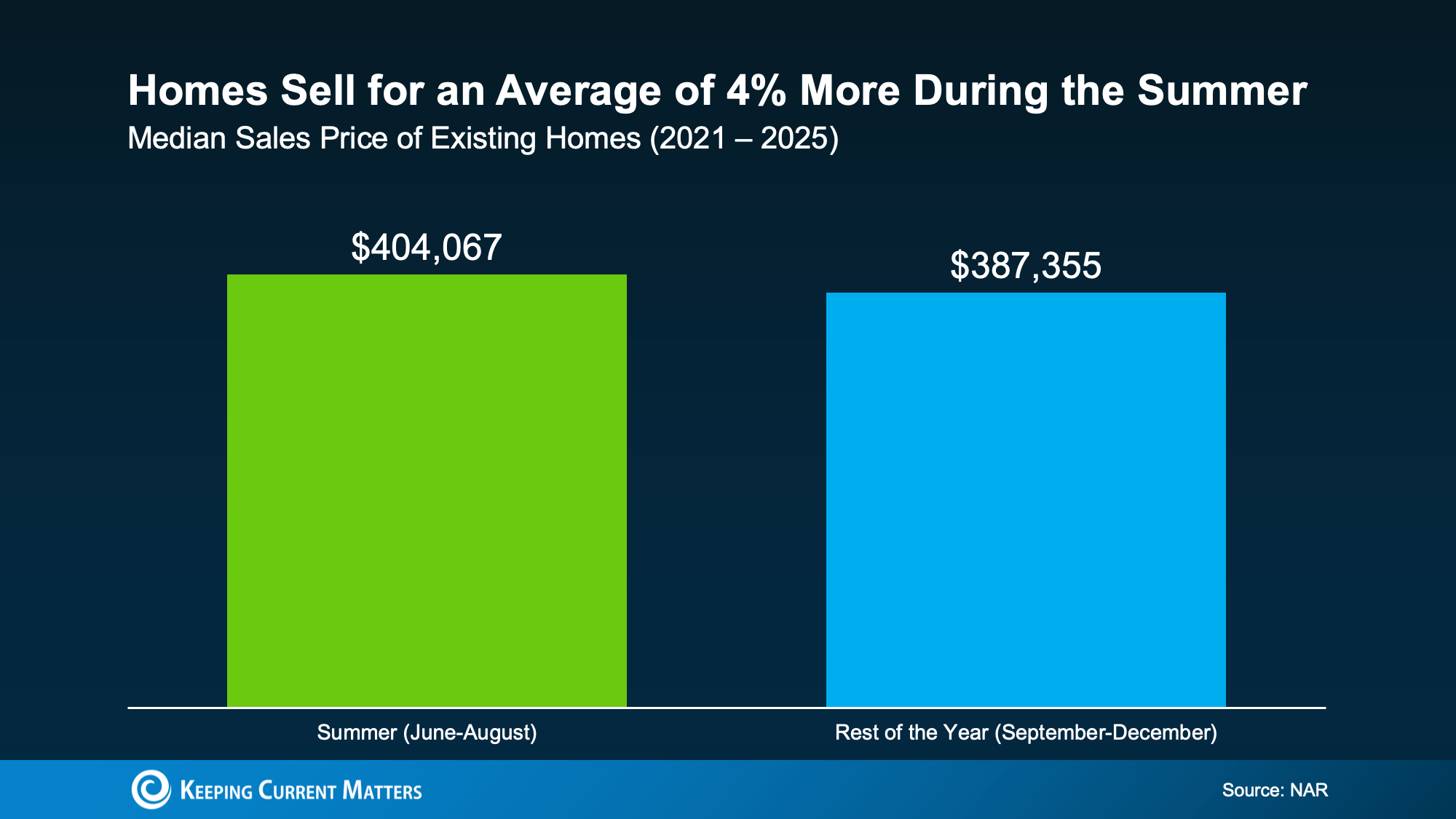
Why? Summer buyers are usually operating on a set timeframe. They’re trying to move before the next school year or when they have more PTO and warmer weather to tour houses. That urgency can translate into better offers.
Now, that doesn’t mean you should price your house 4% higher this Summer. That would actually be a mistake in today’s market.
It just means if you’re looking to get as much for your house as you reasonably can, a Summer move could be a smarter play than waiting until later this year.
Because based on typical seasonality, you may get more for your house than you would if you waited until the Fall or Winter (when there are typically fewer buyers active).
And if you’re considering a move anyway, that’s worth factoring in.
Could waiting until later this year work out? Sure. But it's important to understand what you may gain by moving now too – that way you have the full picture before you decide.
If a 2026 move is on your radar, talk to an agent about what matters most to you. Depending on your priorities, Summer could be your moment.
Source: Keeping Current Matters
Realty Executives Midwest
1310 Plainfield Rd. Ste 2 | Darien, IL 60561
Office: 630-969-8880
E-Mail: experts@realtyexecutives.com

If the housing market feels confusing right now, you’re not alone.
Mortgage rates have risen. Home sales haven’t picked up like expected. And many buyers and sellers are wondering when things are going to feel easier or be more affordable.
The truth is: a lot changed over the first half of this year.
Back at the end of 2025, economists were forecasting a much stronger housing market for 2026. They expected mortgage rates to come down, affordability to improve more dramatically, and home sales to rebound.
But lingering inflation, economic uncertainty, and growing geopolitical tensions overseas pushed mortgage rates higher than expected. And because rates stayed elevated for longer, many buyers continued to hold off.
That’s why experts recently revised their housing forecasts for the rest of the year (see graph below):
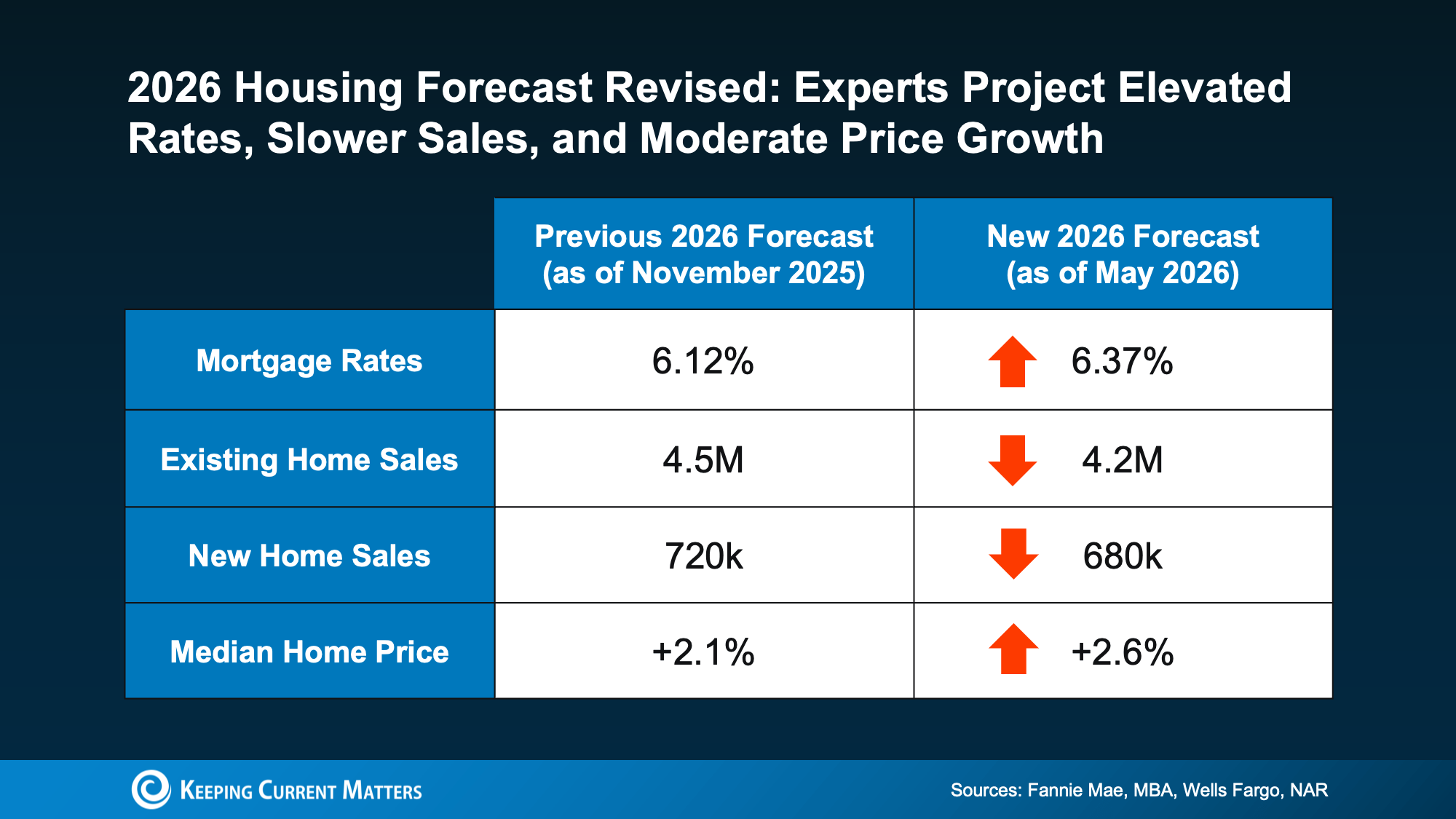
So, what does this actually mean for you? Let’s break it down.
While just about everyone wants mortgage rates to go back to the uppers 5s or low 6s we saw at the start of the year, as of right now, the experts don’t think that’s likely to happen this year.
Instead, forecasts have been updated from the low 6s they originally projected. Many industry organizations are saying rates will stay in roughly the mid 6s this year. The good news is, that’s still lower than rates were a year ago.
Of course, this is based on what we know today. If the conflict overseas comes to an end or inflation drops, this could change. But if you’re waiting for lower rates, it may not pay off in the way you expect.
Back in late 2025, experts expected we’d sell an average of 4.5 million homes this year. Now? That’s dropped down a bit to 4.2 million.
That tells us something important: buyers are still hesitant because affordability remains challenging.
Higher mortgage rates have made monthly payments harder to manage, especially for first-time buyers. And that’s slowed the pace of the market compared to what was originally expected. But even though the forecast was revised down, we’re still expected to sell more homes than last year.
Once geopolitical tensions resolve and rates begin to settle down, many experts believe that group of buyers will be ready to jump back in. As Lawrence Yun, Chief Economist at NAR, explains:
“There is sizable pent-up demand that could be released into the market.”
There has already been a few glimmers of renewed hope lately. In recent months, pending homes sale have been improving month-over-month despite higher rates.
So, if you’re able to afford a home at today’s rates, it could still make sense to buy now. Because otherwise, if you wait, you’ll have more competition (and potentially fewer homes to choose from) when those others buyers jump back in.
Builders also expected to have a stronger year. Earlier forecasts projected new home sales would top 700k in 2026. Now, economists expect we’ll be just shy of that number.
Again, mortgage rates are a major reason why.
But the upside for buyers is that builders may be even more motivated to sell. That means builder incentives, negotiation opportunities, and pricing flexibility may continue in many markets. So, if you live somewhere where there’s more new construction, this may actually be a bright spot for you.
Builders could be more ready to negotiate, and that gives you more leverage to get a better deal.
This is one of the most important takeaways from the entire forecast. Even though sales activity is slower, on average, experts did not revise their home price forecast downward.
They still expect prices to rise nationally this year.
Why? Because while buyer demand has softened, the number of homes for sale is still relatively limited overall. That imbalance is helping support prices, even in a slower market.
Of course, conditions vary depending on where you live. Some markets are cooling more than others. But nationally, experts are still projecting steady price growth — not a major decline. And that should be a comfort whether you’re buying or selling.
Because sellers don’t want a major drop in prices. And while buyers may think they do, generally you feel better about a big purchase when it doesn’t depreciate right away.
The housing market hasn’t rebounded as quickly as experts originally hoped. But that doesn’t mean it’s stalled.
Higher inflation and lingering economic uncertainty caused economists to revise their forecasts for this year. But importantly, when those two things settle down, many experts believe the market will regain its momentum.
So don’t see this revision in forecasts as a sign of trouble. See it as a temporary reaction to overall conditions and uncertainty.
If you want to know what’s happening in your local market, and what it could mean for your plans for the rest of this year, talk to a local agent.
Source: Keeping Current Matters
Realty Executives Midwest
1310 Plainfield Rd. Ste 2 | Darien, IL 60561
Office: 630-969-8880
E-Mail: experts@realtyexecutives.com

You may be telling yourself you’re going to wait to move – maybe you’re hoping mortgage rates will come down, prices will fall, or the market will feel a little easier.
And honestly? A lot of people feel that way right now. But here’s what some are starting to realize.
Waiting doesn’t usually fix the thing that made you want to move in the first place.
Your family still desperately needs more room. Your empty nest still feels too…empty.
Your parents or grandparents still need you to live closer.
You just got married… or divorced.
Your vision of retirement has you living somewhere else.
Eventually, life can reach a point where waiting feels harder than moving.
That’s why some people are still deciding to buy right now, even in today’s market. Not because conditions are perfect. But because the life changes behind their move never really went away.
And maybe that’s exactly where you are too. If so, you’re certainly not alone.
Data from the National Association of Realtors (NAR) shows 1 in 5 buyers last year said they felt like they had to purchase a home at that time, no matter the market.
That’s an important reminder right now. Sure, the dollars and cents of your move have to make sense for you. But big life changes happen whether mortgage rates and home prices are high, low, or somewhere in between.
And those big life events happen more than you may think. NAR says roughly 22.5 million people experience major life changes in a typical two-year span (see graph below):

These are exactly the kinds of things that can change how much space you need, where you want to live, or what kind of lifestyle makes sense now. Chen Zhao, Head of Economics Research at Redfin, explains:
“Life doesn’t stand still—people get new jobs, grow their families, downsize after retirement, or simply want to live in a different neighborhood.”
And that’s what makes waiting so hard. Every month you spend hoping the market changes is another month living in a house that no longer works for your life. It’s stressful to feel stuck. And that feeling usually doesn’t disappear.
But while affordability is still a challenge, there may still be a way for you to make your move.
The number of homes for sale has been growing for 4 straight years (see graph below). That means more homes to choose from and, in some markets, more room to negotiate than buyers had just a few years ago.
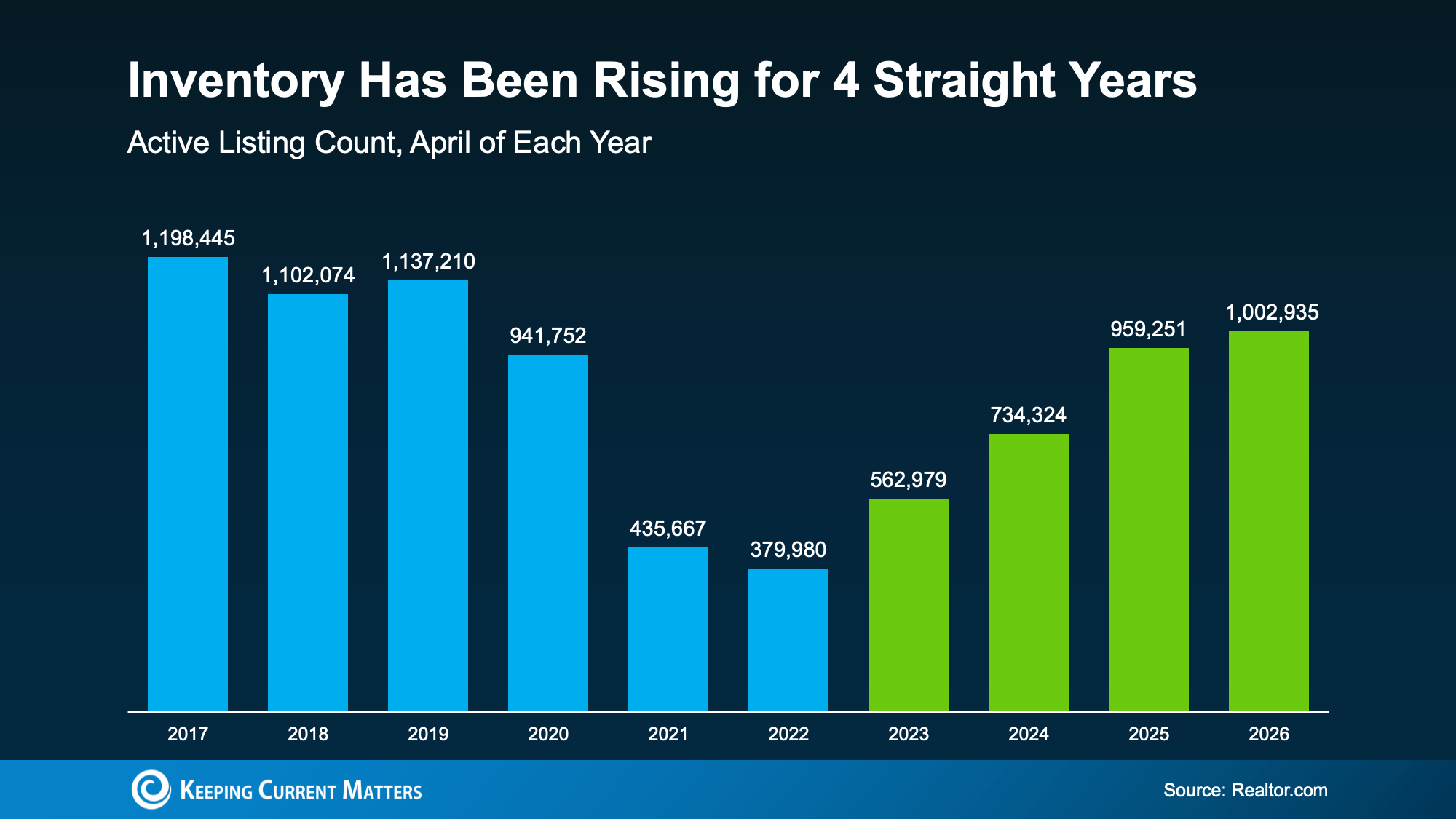
That doesn’t mean moving is suddenly easy. But it does mean some buyers are finding ways to make a move work. So, if you’ve been putting your plans on hold, maybe the question isn’t just:
“What’s the market doing?” or “When will it get better?”
Maybe ask yourself this, too: “Can I still live where I’m at right now and make it work?”
If the answer to that second question is “no,” it may be worth having a conversation about what your options look like today – despite where rates or prices are. You could find your move is still possible after all. With more homes for sale, there’s a better chance to find one that fits your life (and your budget) right now.
Life changes. Priorities shift. Families grow. Kids move out. Careers evolve. And eventually, the house you’re in may stop fitting the life you’re living.
If that’s been weighing on you lately, talk to an agent about what your options could realistically look like today, no matter where rates or prices are.
Life can’t always wait for perfect market conditions. Maybe you don’t have to either.
Source: Keeping Current Matters
Realty Executives Midwest
1310 Plainfield Rd. Ste 2 | Darien, IL 60561
Office: 630-969-8880
E-Mail: experts@realtyexecutives.com

Most sellers come into the market with one number in mind. And it’s often the one that costs them the most. That’s their asking price.
A survey from Realtor.com shows about 8 in 10 (80%) of sellers expect to sell at or above their asking price today. But here’s where things get interesting.
In reality, only about 4 out of every 10 (roughly 40%) actually do.
That’s a big gap. And it’s where a lot of sellers get caught off guard. So, why the disconnect? And how can you set yourself up to be one of the 4 in 10 that get top dollar?
Let’s break it down.
That 40% may sound low at first, but it’s not.
If you look back to the last typical year for the housing market (2019), what we’re really seeing is a return to what’s normal (see chart below). If anything, slightly more homeowners are able to sell above list price today compared to 2019:
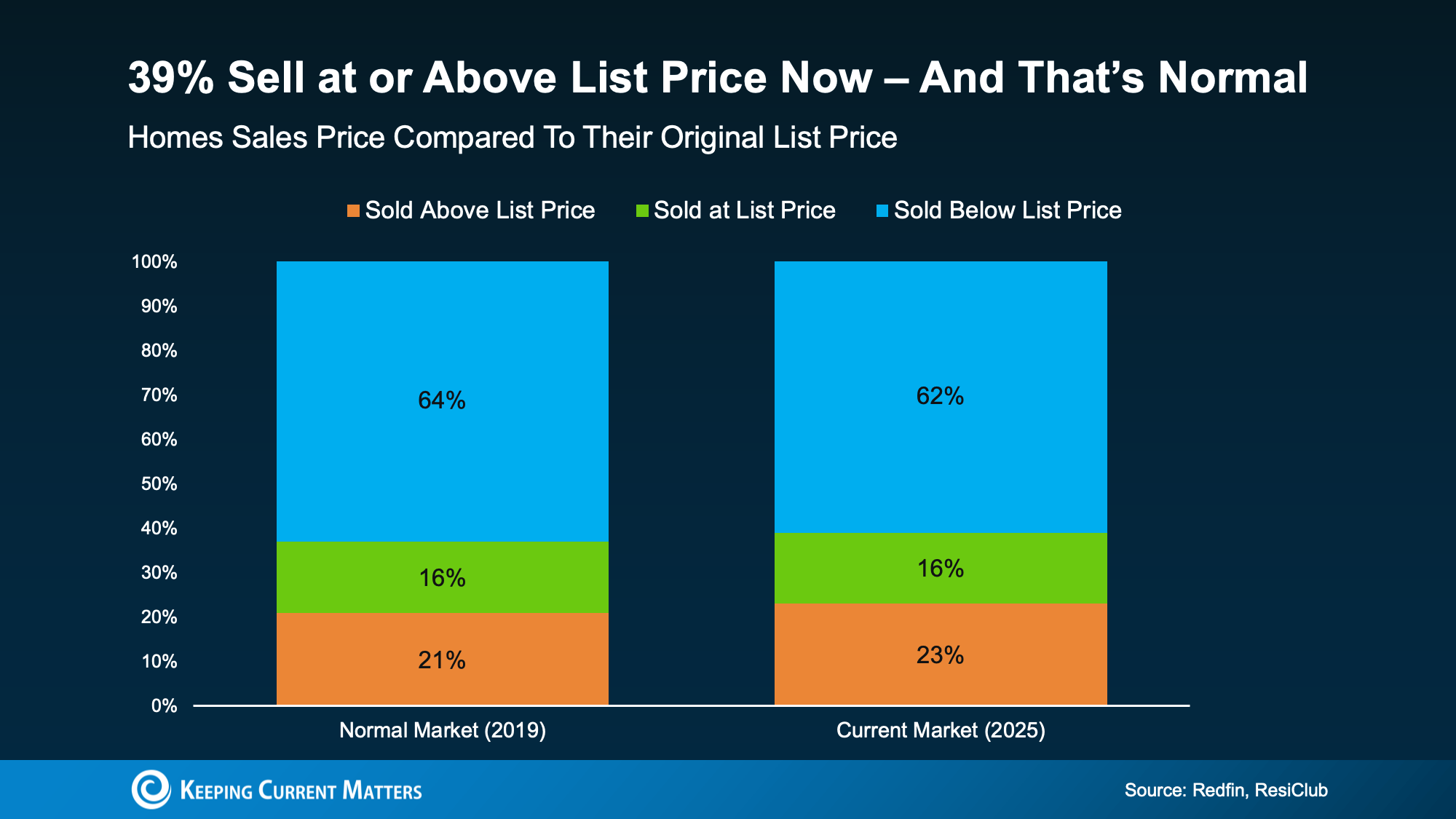 It only feels low because the past few years were anything but typical. Between 2020 and mid-2022, buyer demand was sky-high and the number of homes for sale was at record lows. Almost everything sold over asking.
Now, the market has shifted.
There are more homes for sale. Buyers have more options. And that means they’re more selective about how they spend their money.
In other words, the rules have changed – and pricing like it’s still 2021 is where sellers run into trouble. You have to meet the market where it is if you really want to cash in big.
Here’s the reality. It’s easy to think pricing high gives you room to negotiate. But it usually does the opposite.
When your home is priced above what buyers expect, in this market, they don’t negotiate. They move on.
Because buyers notice price first. And if your home doesn’t line up with similar options in your area, it may not even get a showing. And that’s when things start to snowball:
A high price gets less interest from buyers.
Less interest means fewer offers.
And fewer offers usually means more time on the market.
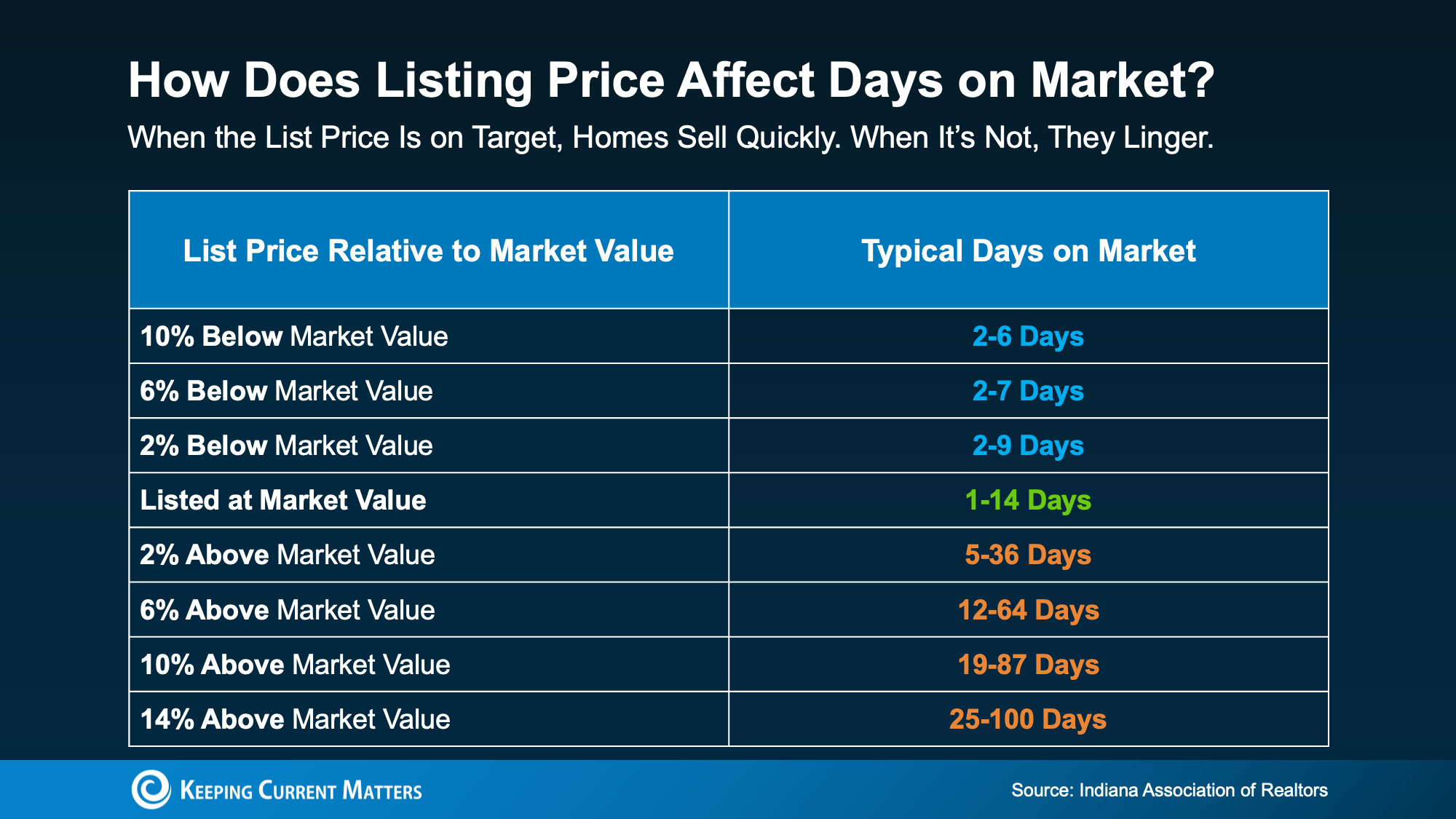
Take a look at this table from the Indiana Association of Realtors. While this data is from one state, the general trend is going to hold true across many markets in the country. It shows that homes listed at or under market value sell fast. But homes priced high? They linger. And that delay comes at a very real cost.
 The Price Cut Trap (And How To Avoid It)
When a home sits that long without offers, a lot of sellers will do a price reduction. According to Realtor.com, 16.7% of sellers are going that route today.
But here’s the real problem. Even a price cut doesn’t guarantee a sale.
In fact, some buyers will see a reduction as a sign something’s wrong with the house – even when nothing is.
That’s why data from the National Association of Realtors (NAR) shows the longer a home sits, the bigger that price cut tends to be to attract buyers back:
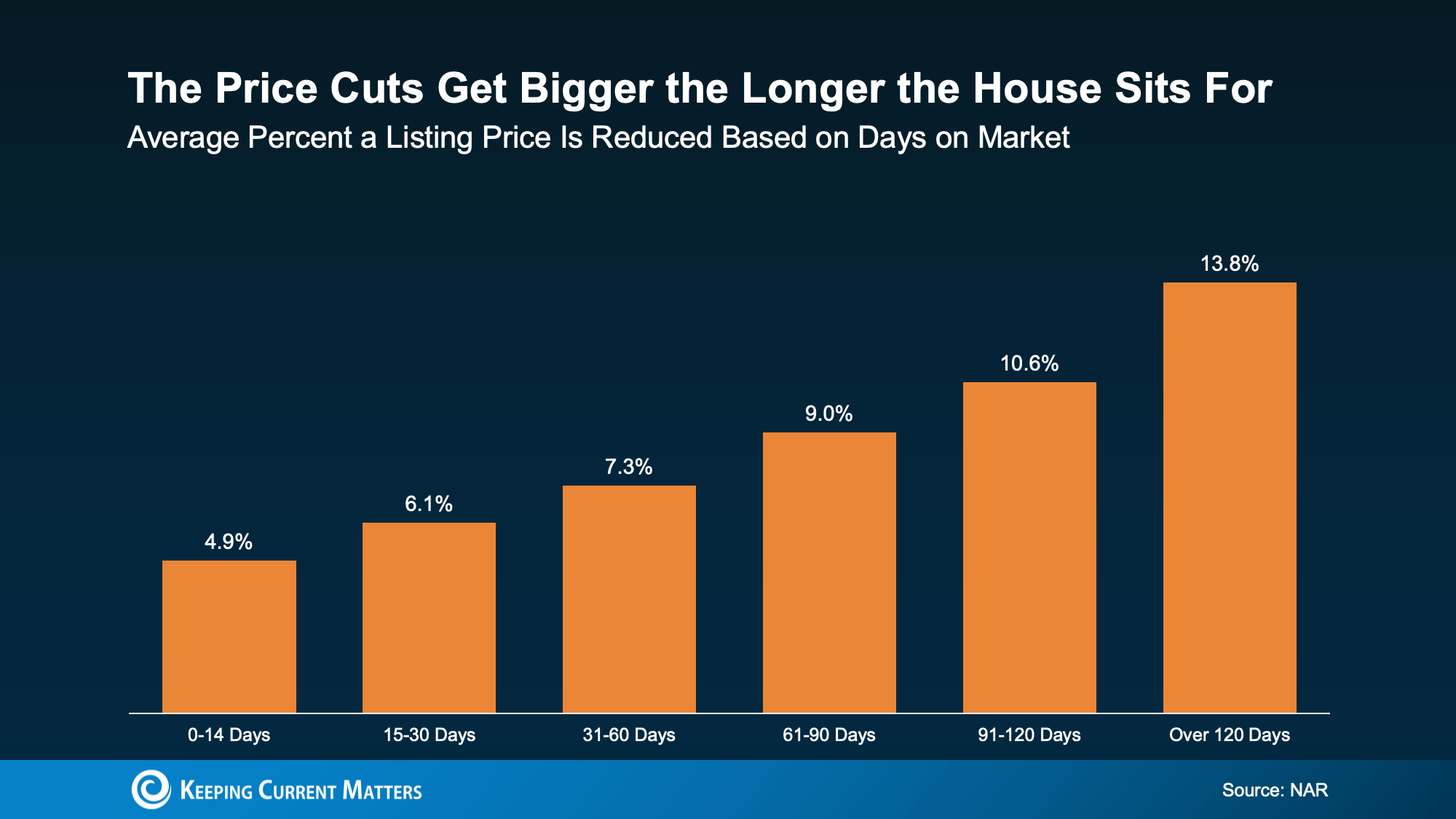 So, what starts as a strategy to “leave room” for negotiate can end up costing you more in the long run.
Even though listing at or even just shy of market value may sound counter intuitive if you’re looking to get as much money for your house as possible, a lot of the time it really is the best strategy.
Because the goal isn’t just to list your house to see what price sticks. It’s to price it in a way that creates demand from day one.
NAR puts it best:
“While some sellers are pricing their homes higher than ever, a more ‘goldilocks’ frame of mind is a better approach to avoid price cuts and lingering time on the market.”
In other words, there’s a sweet spot. Too high, and buyers disappear. Too low, and they question the value.
But right in the middle? That’s where the magic happens.
And that’s where the right agent comes in.
They help you understand what buyers are actually paying right now, how your home compares, and how to price it so it stands out immediately. And in today’s market, that strategy is the difference between:
Listing high, watching it sit, and selling for less later.
Or, pricing it right, creating competition, and putting yourself in a position to win from the start.
A lot of homeowners think they can list high now and negotiate later, but that’s a mistake that costs them. And it’s the reason only 4 out of every 10 sellers are getting their asking price or more.
If you want to be in that group, it starts with getting the price right from day one.
Connect with a local agent to make sure you are.
Source: Keeping Current Matters
Realty Executives Midwest
1310 Plainfield Rd. Ste 2 | Darien, IL 60561
Office: 630-969-8880
E-Mail: experts@realtyexecutives.com
Realty Executives agents are real estate experts. They have the education and expertise you need to navigate through the process of buying or selling a home. From listing at the right price to making the best offer, our Executives have witnessed the best - and most regrettable - decisions homeowners and homebuyers can make. Every day, they are immersed in every aspect of real estate that includes comparable home price analysis, property surveys, credit reports, open houses, HOA agreements, lenders, title companies, homeowners’ insurance, walk-throughs, terms of sale or purchase, repairs, concessions and closing documents. Let our accomplished Executives help navigate you through the process of buying or selling a home.