Realty Executives Midwest

Selling your house this fall is absolutely doable. But there’s something you need to know about this time of year.
Buyer activity typically starts to slow while the number of homes for sale climb – and you need the right strategy to get attention in this type of market.
The good news? There’s a lot you can control.
From how you price and present your house to how you negotiate and respond to feedback. Here are four things you’ll want to get right this fall.
In the fall, there are typically fewer buyers looking and more homes for them to choose from. So, you want to make the most of every buyer who comes across your house.
And your price is one of the first things that can make them stop and take a closer look – or keep scrolling.
That’s why this isn’t the time to start high “just to see what happens.”
If buyers think your house is overpriced, they have plenty of other options to move on to. And that could leave you sitting and waiting.
So, if you want to sell before year-end, work with your agent to find the right price for your house and today’s market. That may mean listing at market value – or even slightly below it – to grab buyers’ attention.
Redfin explains how a seemingly small difference can change your buyer pool:
“Buyers often search in round-number price brackets, so pricing at $499,000 instead of $505,000 can make your home appear in more searches and feel like a better deal.”
When buyers had very few homes to choose from, they were often more willing to overlook dated finishes or a house that needed some work. That’s harder to count on now.
With more choices, how your house looks online and in person can determine whether it makes a buyer’s shortlist at all.
That doesn’t mean you need a full renovation before you sell, but you should take care of essential repairs, do what you can to boost curb appeal, and make sure your house photographs well. Maybe that’s some light staging, maybe it’s swapping out faucets or lights, or maybe a fresh coat of paint. Small details can help a lot.
After all, you only get one chance to make that first impression. Make it count.
Some sellers are still expecting the kind of leverage they had a few years ago. But in many markets, buyers have more negotiating power today and there’s a lot more give and take.
The latest data from Redfin shows 46.2% of sellers gave buyers some type of concession. So, consider throwing in a little help with closing costs or covering a repair. Almost half of sellers are.
The takeaway? Playing hard ball may not get you what you want. But being flexible might. The key is not getting so focused on “winning” every individual negotiation that you lose sight of the bigger goal: making your move happen.
Sometimes a small concession is what gets you to the closing table.
Sometimes your house tells you when something isn’t working. Maybe you’re getting plenty of online views but very few showings. Or buyers are coming through, but you’re not getting offers. Or maybe buyer feedback has one recurring theme.
Pay attention to those signals. They can help you figure out what needs to change.
Let’s say your price is the most common point of feedback. Talk to your agent about a price drop. It doesn’t have to be a big change to make a big difference. The average price cut right now is 4% according to HousingWire Data. That’s normal.
Now, that doesn’t mean you should panic and slash your price after a week. It means you and your agent should pay attention to what buyers are telling you and adjust if you need to.
Sometimes the smartest move isn’t waiting for the right buyer. It’s making sure you’re giving that buyer a reason to act.
Selling this fall is absolutely doable. And now you know four of the biggest things to get right.
If you want to sell before the end of the year, connect with a local agent to make sure you have the right strategy from day one.
Source: Keeping Current Matters
Realty Executives Midwest
1310 Plainfield Rd. Ste 2 | Darien, IL 60561
Office: 630-969-8880
E-Mail: experts@realtyexecutives.com
Ask a couple people how the housing market is doing and you’ll probably get a couple different answers. That’s because right now, the market runs on 2 very different tracks, split by price point.
Knowing which track your house is on changes everything about your sale, from your asking price to how long you can expect to wait before an offer comes in. Here’s what you need to know.
Rates and buyer competition are shaping this market differently depending on price point. Look at recent sales data from the National Association of Realtors (NAR) and the pattern jumps right out.
Homes priced under $250,000 saw sales drop 2-3% compared to last year, while homes priced above $750,000 saw sales climb by double digits (see graph below):
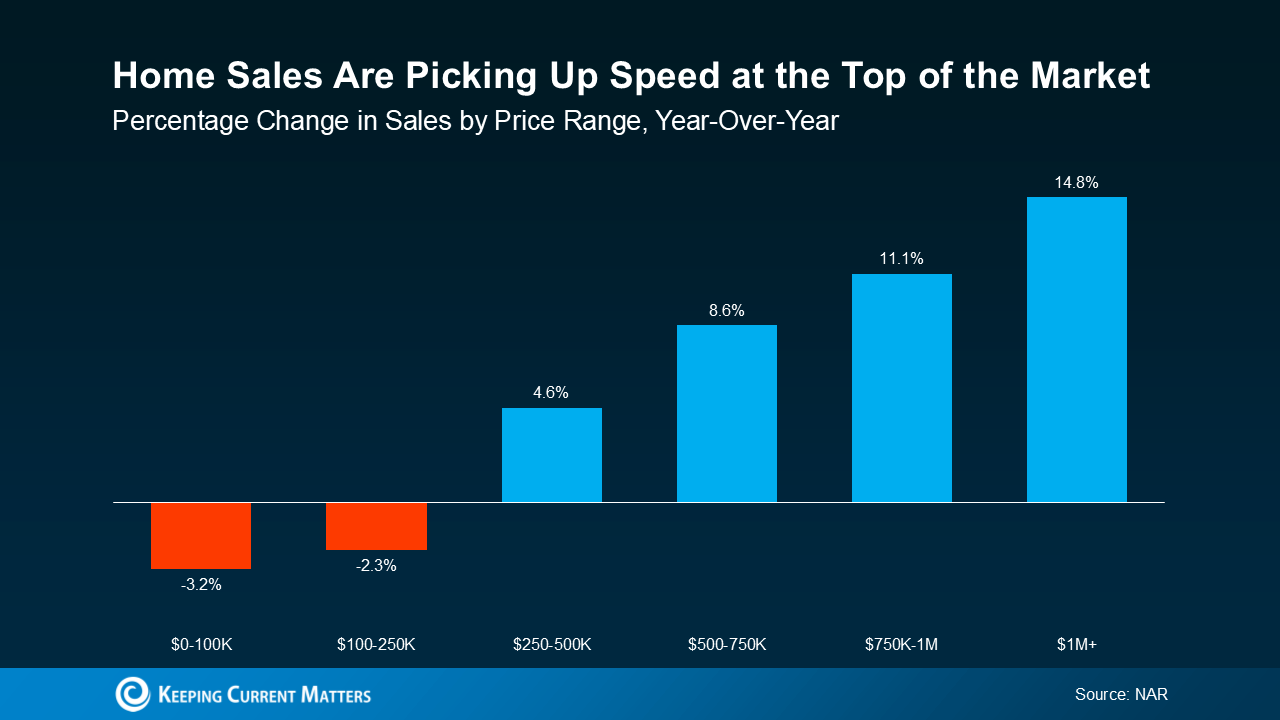 What’s behind the divide? Due to higher rates and the last few years of home price appreciation, fewer buyers can comfortably afford homes at the entry-level price point right now – especially first-time buyers. So, demand in that segment has slowed down.
On the flip side, buyers looking for higher-priced homes have less sensitivity to high-rate environments and more room in their budgets, thanks in part to a strong stock market and their equity in their current home.
That’s the real differentiator. Lower-priced homes are still selling, just not as quickly since today’s rates have shrunk the pool of buyers who can afford to buy their first place right now.
This is exactly why pricing strategy and presentation carry more weight than they used to, especially if you’re selling in that range. Price it right from the start instead of testing a high number, make sure it shows well online and in person, and lean on an agent who can get your listing in front of every buyer shopping in your range. That’s the best way to make sure you catch the attention of one of the buyers who are still looking – and it’s how you prove your home is worth it’s price.
How fast a home sells is shifting by price point too, and the split is just as sharp. For years, luxury homes sat on the market a lot longer than starter homes. That gap has nearly closed, according to Redfin (see chart below):
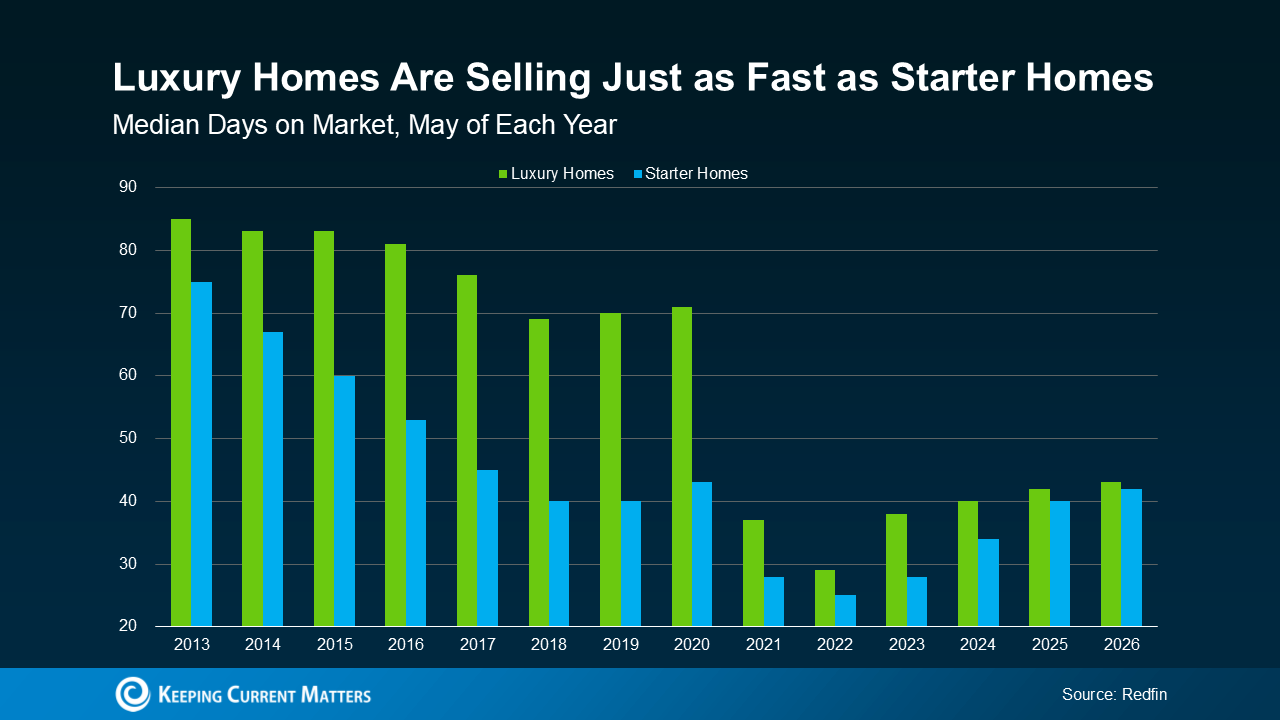 Buyers with deep pockets are moving fast when a well-priced home in their range comes up. As Zillow puts it:
“The U.S. housing market is splitting in two. Luxury homes are selling at a faster pace than a year ago, with shrinking supply and growing bidding wars.”
If you’re in that range, your house may sell faster than you’d expect. You may even get multiple offers. That kind of competition changes how a listing should be marketed and priced from day 1.
And no matter which side you’re on, that’s information you’re going to want up front if you want to have the smoothest sale possible.
If you’re thinking about selling an entry-level home, don’t panic. Homes at your price point are still selling, just at a slower pace than last year. That slower pace means pricing and presentation matter even more right now.
If you’re selling a move-up or luxury house, you’re in a good spot right now. Buyers looking in your price point usually aren’t as affected by today’s rates, so they’re more active, and good listings are drawing real competition.
Either way, your price point is the biggest factor in how fast your house sells and what it sells for.
Your home's price point is the real story right now, more than anything you're hearing in national headlines. Connect with a local real estate agent to map out exactly where your house fits in this split market and build a pricing strategy that gets you the speed and price you're after.
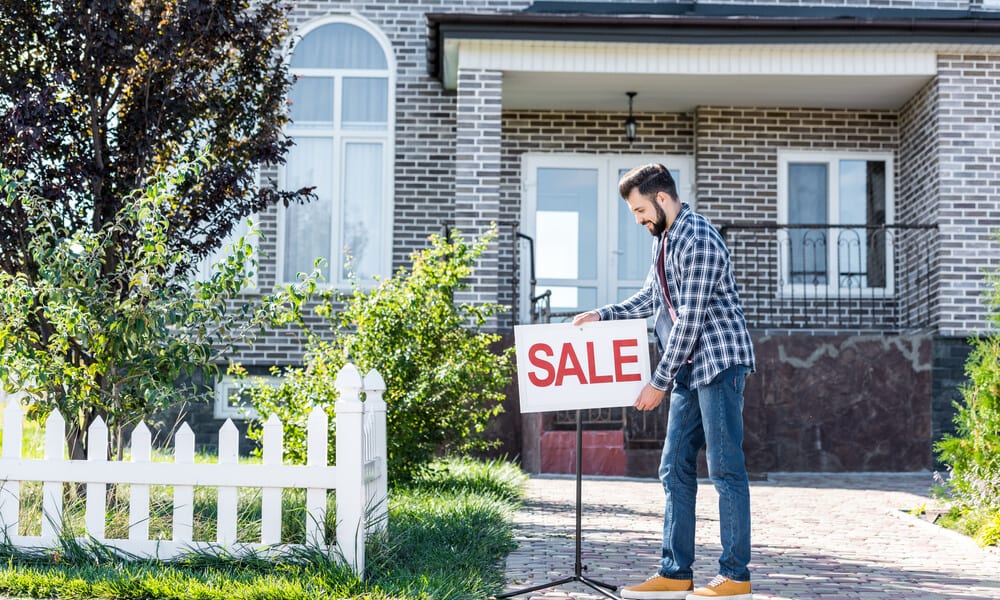
When you hire a real estate professional who is a REALTOR® to help sell your home, you’re gaining a partner with the skills, connections, knowledge and expertise to help you through many decisions aimed at showcasing your home to its fullest potential. Your agent will create a marketing plan; talk with you about listing your home in the multiple listing service (MLS), a marketplace that helps you reach the largest possible pool of serious buyers and maximize the price for your home; and guide you through other steps in preparing your home for sale.
Your agent is also an invaluable ally in helping you ensure privacy and security by managing access during the marketing and transaction process. Why is that important? For one thing, photography and video are ubiquitous today. Everyone who enters your home during the sales process likely has a camera.
Photos of your home are an important part of the sales process, enabling real estate agents and brokers to market your home. Your agent or a professional photographer will be capturing images and video to highlight your home’s best features. With your permission, the listing (with imagery) will be shared on the MLS, which provides it to brokerage websites and portals where buyers search. Others may visit your home with a camera in hand, too. A certified or licensed appraiser may review your home for purposes of providing an appraisal, or a property data collector may gather information to provide to the buyer’s lender. The buyers may choose to have a home inspection. And repair professionals may need access to your home. If you purchase another home and later refinance the mortgage, your lender may send an appraiser or property data collector to that home. In all these scenarios, photos, video or scans may be taken.
Real estate professionals and lenders should have safeguards in place to ensure the security of sensitive data, but there are important steps you can take to make sure you don’t inadvertently share personal information with bad actors in the event of a breach:
Put away anything that reveals personal details, including family photos, visible calendars, mail, computer logins, wi-fi passwords and documents with sensitive information. Even diplomas, awards or books can give away more than you realize.
Lock up jewelry, important and sensitive documents, firearms and prescription medications. A small lockbox or safe is a worthwhile investment to provide peace of mind with visitors coming and going.
Although an agent generally accompanies buyers when they’re in the home, it’s possible for buyers to wander and take photos or videos. Ask your agent to include a “No Photography” note in the MLS, and place polite signage in your home to help deter this.
Electronic lockboxes limit access to real estate professionals who are licensees. Your agent can also use the lockbox to grant one-time access to service providers who are involved in the sale. Electronic lockboxes record exactly who enters your home and when. This is safer than a combination lock, in which the combination could be shared without your knowledge.
Source: National Association of Realtors
Realty Executives Midwest
1310 Plainfield Rd. Ste 2 | Darien, IL 60561
Office: 630-969-8880
E-Mail: experts@realtyexecutives.com

You’re scrolling through listings on your phone and everything looks good until you see the price (or the estimated monthly payment). Then you close the app.
Because even if you love the house, the numbers feel impossible. But here’s the thing.
Nationally, there are more homes sitting on the market than there are people out there looking. And when sellers need buyers more than buyers need sellers, that shows up in the price.
Lower asking prices. More price cuts. And homes priced for what buyers can actually afford – not what sellers hope someone might pay.
And it may be enough to make buying more doable than you’d think.
One of the clearest signs sellers are adjusting? Price cuts. HousingWire Data shows more than 40% of sellers are dropping this price.
That’s just slightly behind the volume we saw last year (see graph below):
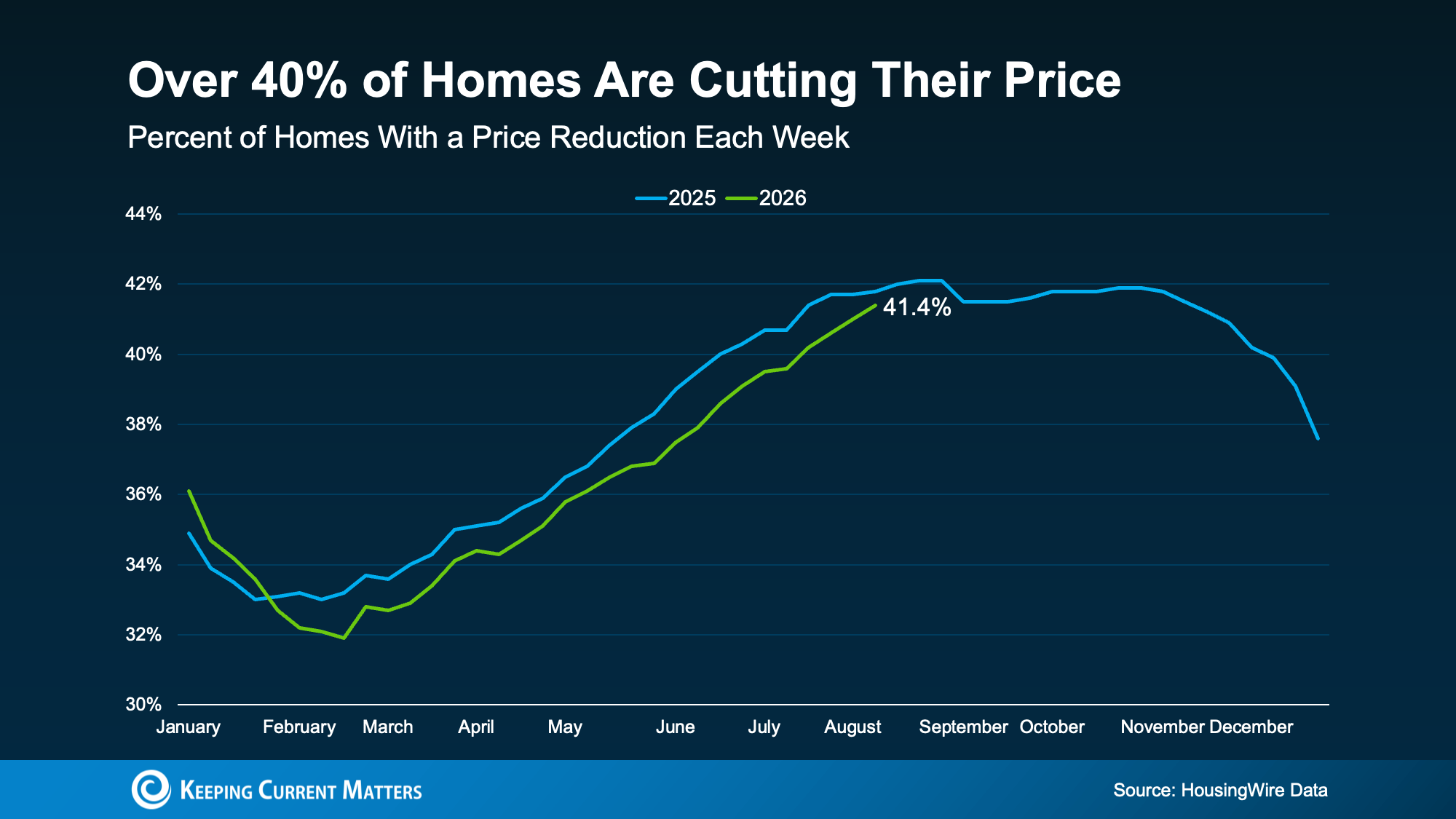
That’s more than 4 out of every 10 homes listed. Think about what that means. That’s thousands of sellers deciding they’d rather lower their asking price than keep waiting for someone willing to stretch their budget.
They know that to sell, they have to be willing to do some give and take. And when no buyers are biting, they’re pulling their biggest lever to draw buyers back in – their price. As Danielle Hale, Chief Economist at Realtor.com, explains:
“This is a market where people are adjusting and showing up rather than giving up. Sellers are meeting the market with more realistic asking prices, which is helping deals get done.”
What about the other 6 in 10 sellers? A lot of them started with a lower asking price to begin with rather than test the higher price and get crickets from buyers.
That may be why July 2026 had the lowest median list price of any July in the past five years, according to Realtor.com (see the white line in the graph below):
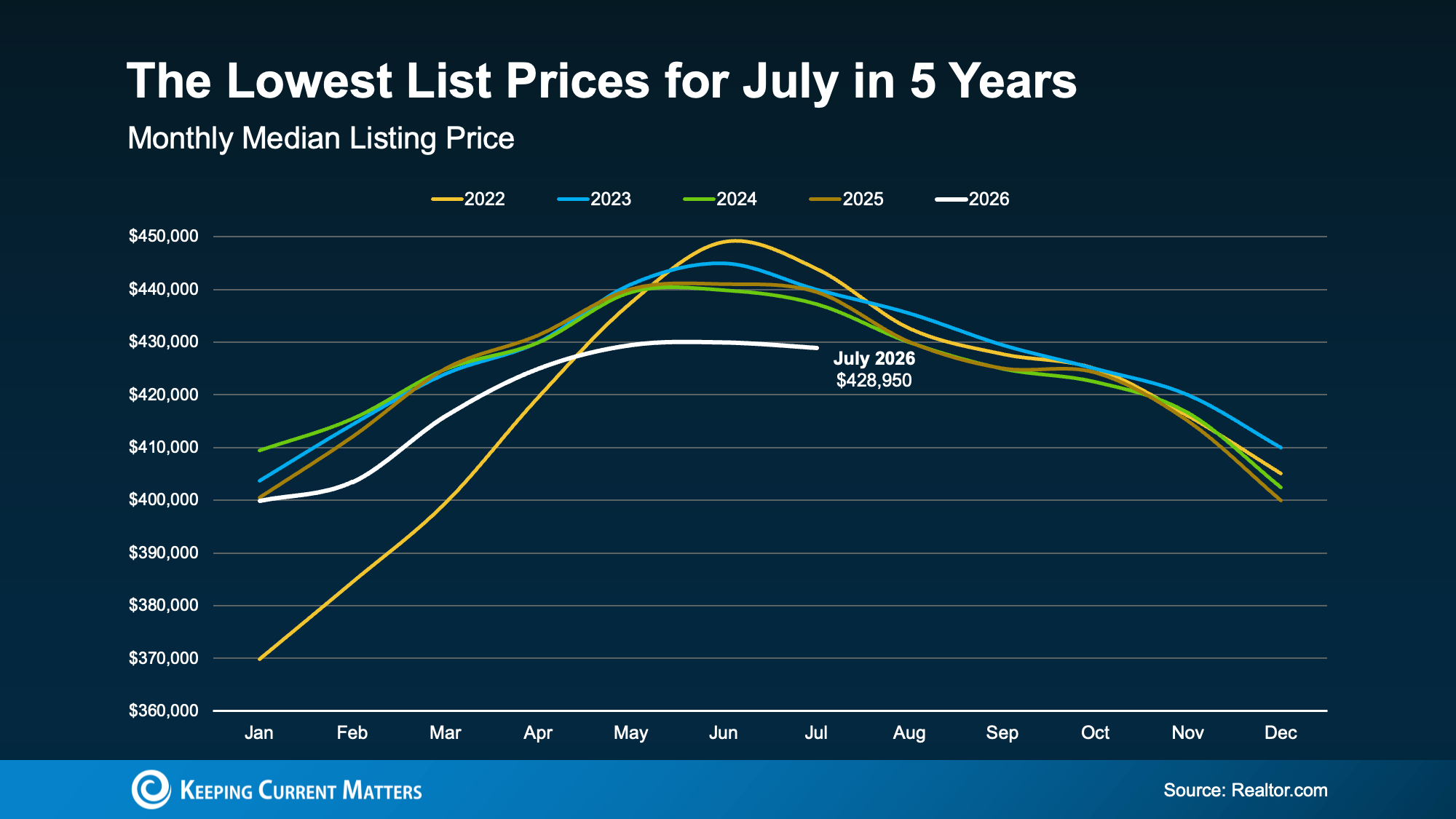
Now, that doesn’t mean home values are falling or that everything’s suddenly a steal. Prices are still above where they were before the pandemic. But what it does mean is this.
Sellers no longer banking on bidding wars or expecting buyers to pay whatever they ask. Instead, many are listing at prices that better reflect today’s market from the very beginning.
And honestly, whether they’re pricing competitively from day one or adjusting after a few weeks on the market, the message for you is the same:
Sellers are more willing to meet you where you’re at.
Because in many markets throughout the country, you’re not fighting over a house anymore. Sellers are fighting over you. And that’s information you can use to get a better deal.
Yes, affordability can be a real challenge. And the monthly payment you take on definitely does matter. But if you’ve been assuming everything is out of budget, there may be more wiggle room than you think.
Right now, sellers are flexible on the price in ways they weren't before. Reach out to a local agent to take advantage of that flexibility.
Source:Keeping Current Matters
Realty Executives Midwest
1310 Plainfield Rd. Ste 2 | Darien, IL 60561
Office: 630-969-8880
E-Mail: experts@realtyexecutives.com
Most agents assume spring is the only market worth chasing. If you've been in this business long enough, though, you know late summer tells a different story — and the agents who get that are the ones closing deals while everyone else waits for next April.
There's a reason late summer gets written off — it feels slower. But feeling slow and being slow are two very different things. When the market quiets down, the clutter clears. Fewer listings mean more eyes on yours, and more eyes on yours mean your sellers have a real shot at the kind of weekend they actually hoped for when they decided to list.
Serious buyers don't vanish after Memorial Day — they just get quieter. Families who missed their spring window are still out there, still looking. Relocating professionals are working against real deadlines. And plenty of buyers who've been watching rates are getting impatient, knowing they can't wait forever.
What does that add up to for your listings? Motivated buyers with genuine urgency — the kind your sellers actually want coming through the door.
When other agents and sellers pull back for vacations and back-to-school prep, inventory tightens. Lower supply plus consistent demand creates conditions where pricing confidence is easier to defend — and your listings get more eyeballs simply because there are fewer of them.
Here's what typically defines this window:
Late summer might honestly be the best time of year for a home to look the part. Landscaping is lush, daylight is long, and photography conditions stay favorable well into the evening. For listings where first impressions drive offers — which is nearly all of them — that's not a small thing.
A few ways to help your sellers take full advantage:
Favorable conditions don't replace strategy. Even with tighter inventory, an overpriced home will sit — and sitting in late summer carries real consequences as the fall slowdown creeps closer. Help your sellers understand that a well-priced home in August almost always outperforms one relisted at the same number come October.
Your pricing conversations this time of year should factor in:
The agents who make the most of this season aren't doing anything complicated. They're pricing with confidence, marketing consistently, and running on systems that don't get in the way. That's a repeatable edge — and it starts with having the right foundation before the market shifts again.
If your current setup isn't keeping pace, now's a good time to see what a purpose-built platform actually looks like in practice.
Realty Executives agents are real estate experts. They have the education and expertise you need to navigate through the process of buying or selling a home. From listing at the right price to making the best offer, our Executives have witnessed the best - and most regrettable - decisions homeowners and homebuyers can make. Every day, they are immersed in every aspect of real estate that includes comparable home price analysis, property surveys, credit reports, open houses, HOA agreements, lenders, title companies, homeowners’ insurance, walk-throughs, terms of sale or purchase, repairs, concessions and closing documents. Let our accomplished Executives help navigate you through the process of buying or selling a home.