Realty Executives of Northern Arizona
Known for its towering ponderosa pines and cool mountain air, Flagstaff, Arizona, may seem an unlikely place to find deep connections to space exploration. But beneath its serene surface lies a rich history of astronomical discovery and lunar preparation—making Flagstaff not only a haven for outdoor lovers but also a hidden hub for scientists, astronauts, and star-gazers alike.
From Apollo 11 through Apollo 17, all twelve astronauts who eventually set foot on the lunar surface underwent geological and surface operations training in the Flagstaff area. Flagstaff’s USGS Astrogeology Science Center coordinated much of this training. Surrounding volcanic sites—like Sunset Crater, Merriam Crater, and especially the Cinder Lake Crater Field (a man-made replica of a lunar surface)—offered realistic terrain for practicing the kinds of exploration they would do on the Moon.
Flagstaff’s journey into space science began in 1894 with the establishment of Lowell Observatory by astronomer Percival Lowell. Set on Mars Hill, this historic site played a pivotal role in planetary studies, culminating in the 1930 discovery of Pluto by Clyde Tombaugh. To this day, the observatory remains an active research center and a popular destination for those hoping to glimpse distant worlds through its telescopes.
In the 1960s, Flagstaff’s landscape became an essential training ground for the Apollo Moon missions. The U.S. Geological Survey (USGS) Astrogeology Science Center, still headquartered in the city, worked with NASA to create lunar-like terrain in areas such as Sunset Crater and Cinder Lake Crater Field. Using explosives, engineers crafted realistic craters where astronauts—including Neil Armstrong and Buzz Aldrin—practiced collecting samples, navigating the terrain, and operating lunar equipment.
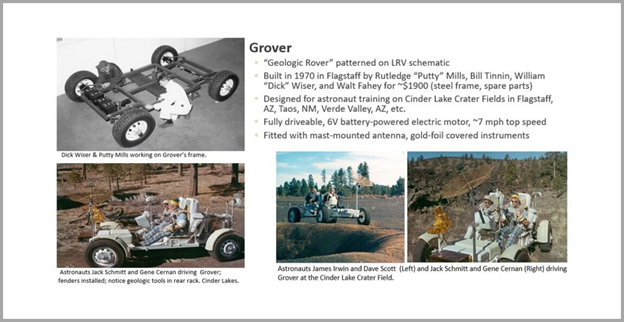
One of the most significant relics from that era is "Grover," a geological-lunar rover trainer built in Flagstaff in 1970. Used to prepare astronauts for the challenges of driving on the Moon, Grover is now proudly displayed in the lobby of the USGS Astrogeology Center, serving as a tangible link to the city's role in lunar exploration.
Today, Flagstaff continues to support NASA missions through planetary mapping, remote sensing, and public science outreach. Visitors can tour Lowell Observatory, hike through volcanic landscapes where astronauts once trained, and see Grover—the lunar rover trainer that helped carry humans to the Moon.
Flagstaff is more than just a picturesque mountain town. It’s where the natural world and the cosmos come together, offering a rare blend of history, geology, and space science. Whether you’re staring up at the stars or walking the same ground as Apollo astronauts, you’ll find yourself in a place where Earth meets the universe.
While looking up, don't forget to keep your feet on the ground, and maybe put down roots in northern Arizona. To learn more about the area and the local housing market, come by the office or call to speak to one of our on-site, and knowledgeable Realtors®!
Where the Experts are - Serving Flagstaff and Northern Arizona since 1977
 |
|
 |