Every Monday, I take a look at the latest Pima County housing numbers.
Not because the market suddenly becomes completely different from one Monday to the next, but because watching the movement over several weeks often tells us more than any single report can.
And lately, the story has been fairly consistent.
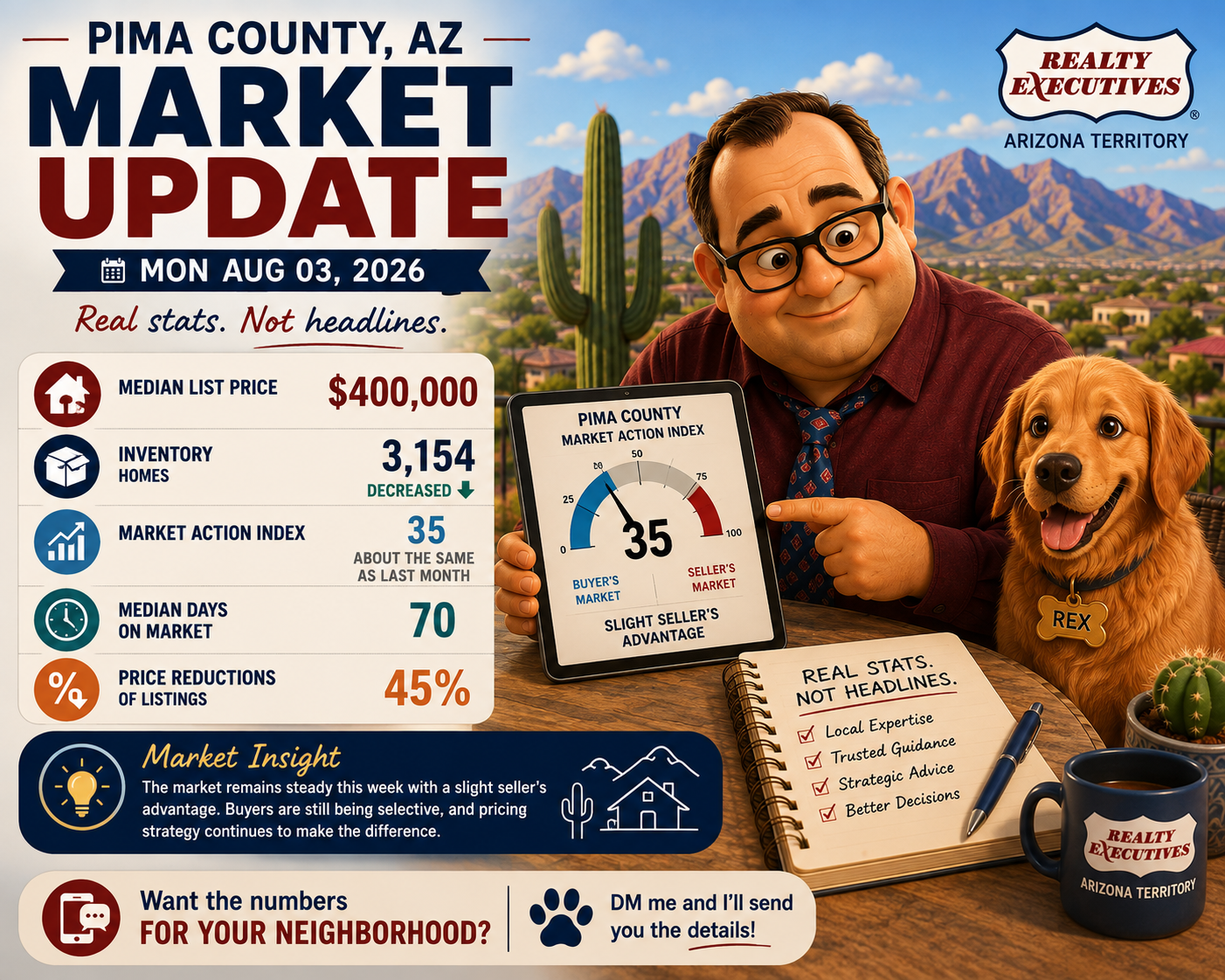
The median list price has gradually moved down from around $425,000 earlier this summer to $400,000 this week. Homes are also taking a little longer to sell, and the percentage of listings reducing their price continues to hover near 45%.
At the same time, inventory has not surged, and the Market Action Index has barely moved.
That is why I would describe this as a market that is adjusting—not one that has suddenly shifted entirely in favor of buyers or sellers.
This Week’s Pima County Market Snapshot
- Median list price: $400,000
- Median price of new listings: $390,250
- Price per square foot: $224
- Median days on market: 70
- Average days on market: 111
- Listings with a price reduction: 45%
- Listings with a price increase: 2%
- Relisted homes: 9%
- Active inventory: 3,154 homes
- Median rent: $1,900
- Market Action Index: 35
- Overall market position: Slight seller’s advantage
So, What Has Actually Changed?
The most noticeable change over the past couple of months has been the gradual movement in asking prices.
We are not seeing one dramatic weekly drop. Instead, the median list price has been slowly working its way lower.
We have also watched median days on market move from the low 60s to around 70 days. That may not sound like a major difference, but it supports what we are seeing elsewhere: buyers are taking more time and being more selective.
What has not changed very much is the overall balance of the market.
The Market Action Index has stayed in the mid-30s for several weeks. It was around 36 earlier in the summer and is now 35. That still gives sellers a slight advantage, but it is not a strong seller’s market where buyers are expected to overlook condition or accept any asking price.
Inventory has also remained relatively steady. It has moved up and down from week to week, but we have not seen the large increase that would normally signal a sudden swing into a strong buyer’s market.
The Number I Keep Watching
Nearly half of the homes currently for sale have reduced their price.
That percentage has remained remarkably consistent over the past several weeks—generally somewhere between 44% and 46%.
To me, that is one of the clearest signs of what is happening.
Buyers have not disappeared. They are still purchasing homes. But they are paying attention, comparing their choices and pushing back when a home does not appear to offer the right value.
This is not a market that has stopped. It is a market that is making sellers prove their price.
What Does This Mean If You Are Selling?
If we were sitting at your kitchen table talking about selling your home, I would not tell you the market is bad.
I also would not point to the words “slight seller’s advantage” and promise that selling will be easy.
I would want to look at what has happened in your neighborhood, what you would be competing against and how buyers are responding to homes similar to yours.
The fact that asking prices have been gradually moving lower does not mean every home is losing value. It means sellers need to be more realistic about where buyers see value today.
A home that comes onto the market at a price buyers can understand may still receive good attention. A home that starts too high can lose its early momentum and eventually become one of the 45% that has to reduce its price.
That does not mean pricing low.
It means pricing with a plan.
What Does This Mean If You Are Buying?
Buyers have more room to be thoughtful than they did in a much faster market.
There may be opportunities with homes that have been sitting longer, reduced their price or returned to the market. But that does not mean every seller is desperate or that every home should receive a deeply discounted offer.
Inventory is still limited enough that a well-priced home in good condition can attract strong interest.
The strategy needs to match the property.
I would never tell a buyer, “The market is cooling, so offer whatever you want,” any more than I would tell a seller, “Inventory is limited, so you hold all the cards.”
Neither statement tells the entire story.
Countywide Numbers Are Only the Starting Point
It is important to remember that this report looks at Pima County as a whole.
Pima County covers a very large and diverse area with many different communities, price ranges, property types and individual subdivisions. A countywide median can help us understand the general direction of the market, but it cannot tell us exactly what is happening in every neighborhood.
One part of Tucson may have very limited inventory and homes selling quickly, while another area may have more competition, longer market times and frequent price reductions.
Even two nearby subdivisions can behave very differently depending on price, condition, amenities and buyer demand.
So, while these weekly numbers are helpful, they are really the beginning of the conversation—not the final answer.
The Bigger Picture
Over the last several weeks, asking prices have moved lower, homes have taken a little longer to sell and price reductions have remained common.
What we have not seen is a dramatic increase in inventory or a major change in the Market Action Index.
Put those pieces together, and this looks less like a market falling apart and more like one slowly finding its balance.
That is why weekly statistics are useful—but only when we compare them with what we have been seeing over time.
Real stats tell a much better story than national headlines. But even the statistics need context.
Real estate is local—and sometimes it is local down to the individual subdivision.
If you are seriously considering buying or selling, let’s look more closely at the area you are in or the neighborhoods you are considering. That is where the information becomes much more useful and specific to the decision you are actually trying to make.
I would be happy to sit down with you, look at the numbers and help you understand what they mean for your situation.
View the Full Market Report
The countywide statistics referenced in this update are provided by Altos Research. You can review the complete Pima County market report and its supporting data here:
View the full Pima County market report
Market information is a countywide snapshot and may not reflect conditions within a specific neighborhood, subdivision, property type or price range.
Jesse Lapham
Real Estate Specialist for Tucson & Surrounding Areas
Realty Executives Arizona Territory
520-870-1142
Tucson@azjesse.com