Wayne McCormick
Broker/Owner
Realty Executives of Northern Arizona
By Rosie Romero
There's nothing plain about concrete floors anymore.
It used to be that a homeowner who opted for a concrete patio simply wanted an inexpensive, no-fuss floor.
Today, concrete has become a material of choice for homeowners, and decorative finishes have become high style-even on new slabs. "Now, it's a big upgrade to a house," says Wacey Barta, who owns Second Time Around Custom Concrete Coating in Phoenix. "It gives a floor a nice, finished look."
Do-it-yourselfers and contractors are dressing up concrete patios with acid stains in every color, with overlays that mimic the look of flagstone and other more expensive, natural materials, and with distinctive stamps.
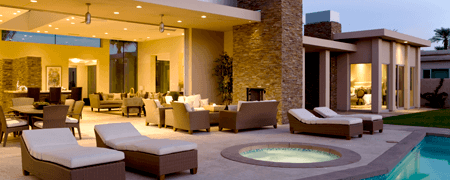
And exposed concrete isn't just for outdoor floors. Homeowners are stripping their carpets and vinyl tiles to reveal the concrete floors underneath in kitchens and even living rooms in homes at all price points.
Some of the most popular ways to turn a drab slab into something fancy underfoot include:
• Stamped concrete. Patterns and textures are pressed into newly poured concrete before it's fully dry. Combined with stains that add realistic color, stamped concrete can imitate the look of brick, cobblestones, flagstone, wood, pebbles or even seashells - at a fraction of the price. Plan to pay around $6 to $8 per square foot for stamped concrete with a single pattern and color, more for elaborate designs. This is more a job for a contractor than a do-it-yourselfer.
• Overlays. Another option for turning a scuffed-up, plain-Jane concrete patio floor into a fabulous faux-stone centerpiece for your outdoor room is the overlay. Also a job best left to a pro, an overlay involves laying a scratch coat of a high-polymer modified concrete over your old slab, taping out a flagstone, cobblestone or other pattern with grout tape, and then pouring another thin layer over that for texture. When you remove the tape from the almost-dry floor, it leaves impressions to look like grout lines, and when you add lifelike color, you'll fool most people into believing you have a genuine stone floor. Overlays cost from around $3.50 to $6.50 per square foot, depending on how elaborate your design and how large your patio. (Ask your contractor for a discount on a large floor.)
• Acid stains. One of the most popular ways to dress up a concrete floor, acid staining permanently changes the color of concrete, because the pigment soaks deep into its pores. A confident do-it-yourselfer can apply the stain by spraying one to three coats onto the floor, then neutralizing the acid with ammonia and water, and finally, sealing the floor to protect the new finish. Depending on how much prep work your concrete floor needs - and prep work can be the biggest part of the job - you'll pay a contractor around $2 to $6 a square foot for labor and materials.
By James Dulley
Starcott Media Services
Before attempting any door improvements, inspect each door, especially the wood door.
If the wood is warped, there is not much you can do but replace it.
Steel or fiberglass doors seldom warp, so they can be upgraded for better efficiency. If you feel air leakage around the door, push on the door with your hand to force the door to close tighter and check again for leaks. If you are lucking, the door is just not closing tightly enough to seal well.
The easiest solution is to install an adjustable latch plate to hold the closed door stripping in the frame.
An easy to install design, by Mag Manufacturing, uses a two piece striker plate.
One piece fits where your old striker plate was mounted. The second piece, into which the door latches, can be adjusted over the first piece to hold the door tightly closed.
Most thresholds’ seals are adjustable. They usually have screws that allow you to move them up or down. The screw heads may be covered with packed dirt from years of use, so you may have to pick around to find them. Adjust the threshold up a little to see if this reduces the draft.
If the doors are old, replace the threshold seal or perhaps the entire threshold. Most newer doors have the weatherstripping attached to the door bottom, but some older ones have the seal in the threshold, where it can get damaged.
If you install a new efficient threshold seal, you will have to remove the door from the hinges.
The new seal will be thicker, so saw a thin strip off the door (wood or fiberglass) bottom.
For a steel door, install an automatic door bottom seal that moves down to touch the threshold just as the door closes.
Worn hinges also can cause sealing problems. These allow the door to hang crooked so the weatherstripping will not seal well.
Most home centers carry an array of hinge sizes, which fit almost any door.
The glass in doors is the lowest insulation component. Make a storm pane using clear acrylic plastic, to cover the glass in the door. This will double the insulation value and protect any decorative door glass.
If you can remove the door molding, check to see if there is insulation in the gap around the doorframe.
If you fine none, spray expanding foam insulation into the gap.
The new EZ-Fit Safety Gate Adapter allows you to install a child safety gate on your stairs without drilling holes into the woodwork and ruining your banister.
The Gate Adapter that comes from a Georgia company " 'boutKIDS Inc. is a wood support that is secured to your banister post by attaching foam tape and straps. The support then becomes the surface to which a pressure-mounted or hardware-mounted gate can be attached.
The EZ-Fit Safety Gate Adapter won an iParenting Media Award in the safety category.
The Adapter is available for purchase through a variety of stores, web sites, and catalogs. The company's web site; www.boutkids.com has a list of locations the adapter is available.. It can also be purchased directly from the company online for the cost of $19.99.
Comparing the most popular patio surfaces:
* Composite Decking is made from Recycled Plastic and Re-Claimed Wood, is splinter-free, resists insects and does not rot. It needs no staining because the color is manufactured into the product. It is easy to maintain by cleaning with soap, water and a stiff bristle brush or broom. The material can feel hot to bare feet and the sun can cause it to expand and the color to fade. The cost is about $4 to $5.50 per square foot for the material. If you choose to hire it to be installed you are looking at $35 per square foot installed by a professional.
* Western Red Cedar and Redwood are choices that have been around for a long time. This is due to the fact that these choices of wood are long-lasting and they naturally resist decay. Under the sun the wood can turn gray unless it is re-sealed every few years with a water repellent preservative. The cost for Cedar is around $4.25 per square foot for the wood only and can run $14 to $20 per square foot installed by a professional. Redwood on the other hand can be up to $10 per square foot for the wood only and installed professionally can run $15 to $22 per square foot.
* You can bring the look and feel of "Old Mexico" to your patio by using Saltillo Tiles. These are Clay Tiles that are highly porous and require re-sealing because of the scuffing and staining that will occur. This tile performs well in dry weather or a covered shady area. The cost for the Tiles for materials only is $1.20 to $2 per square foot (12" square tile). The tiles can be inexpensive to purchase the materials, but can be expensive to install. To install professionally, you are looking at $6 to $7 per square foot (or per tile).
* Another popular do-it-yourself material is Concrete Pavers or Paving Stones. They aren't set in a mortar, so this makes them a popular choice for a project. These pre-formed concrete pavers get hot in full sun, but perform well in Arizona's Hot Dry Climate. You can expect weeds to grow between the stones if you don't maintain them with an herbicide. The cost of the Pavers is $2 to $8 per square foot, materials only. To have them installed professionally you can expect to pay $8 to $22 per square foot.
* For an inexpensive do-it-yourself project, you can use Poured Concrete. This can be Colored to mimic real stone or wood and can be stamped to look like individual stones. Concrete expands in the heat and cold, so it can crack. You can clean this very easily with soap and a garden hose or brush off with a broom. The Poured Concrete can cost about $1.25 per square foot for the materials and to install professionally you are looking at $4 per square foot.
* Flagstone is another Durable Product that can be used for Patio Surface. The size of the Flagstone can make it difficult to work with due to their weight. Flagstone can get hot under bare feet and can be slippery when they get wet. They are very easy to maintain by sweeping them clean. The cost for Flagstone is $3 to $10 per square foot for the materials. To install professionally you are looking at $12 to $20 per square foot.
* Ancient Stone is an ivory-colored tile that is Cast Concrete that is set in sand or over a concrete base. These are made from a cement base but can have color added to make them look like natural stone. Pits in the tiles help it to stay cooler than other alternative choices of Patio Surfaces. The cost for materials is $5 to $9 per square foot. Professionally installed this can run up to $14.50 per square foot.
When considering installing or replacing an outdoor patio, there are several things for you to think about: price, level of difficulty in installation, maintenance and style as well as surface temperature. Ancient Stone stays about the same temperature as the outdoor air; Slate and Wood are Cooler Choices but, the plastic/wood composite is nearly as hot as a street. The gray troweled concrete is about the coolest at 128 degrees on 112 degree day. It's all a matter of choice for your area and needs.
Do you wake up to a thumping sound when the water sprinklers come one? Or is the hammering noise greeting you at random times throughout the day when you turn off a faucet? Perhaps it’s just a low, annoying vibration in the walls. When the banging and clanging start happening in the plumbing pipes, what’s a homeowner to do?
This is a common problem that many homeowners believe they must endure. The noise is a “water hammer” produced when the toilet float valve or faucets in the house shut off suddenly. It creates a pressure surge due to a sudden change in flow rate. Think of it as a traffic jam in your pipes. This should be eliminated as soon as possible to avoid possible damages to the pipes.
There are two types of water hammers. One sounds like someone banging on your pipes while another is more like a humming, vibrating sound. They are caused by two different things. Vibrations are usually caused by loose pipes. Secure these pipes by strapping them to the wall. Some homeowners have found that wrapping insulations around loose pipes in addition to securing them helps eliminate the problem. A plumber can assist you with this project because it requires opening holes in drywall and crawling through the attic.
The banging “water hammer” can be caused by different things. First, determine when the banging occurs. One common time is whenever a toilet flushes. To remedy the situation, try installing a fluid-master-style float valve (the type without the float on an arm) in your toilet tank. These are available at hardware stores and come with good installation instructions, which make this a fairly easy do-it-yourself project.
Another cause is high water pressure. Leaving this high pressure untreated can cause pipes to break or explode. To find out whether high water pressure is your problem, a pressure gauge can help you check the pressure on your house. Ideally, the pressure should not be more than 75 pounds per square inch. If high water pressure is the problem, the solution is to have a plumber install a pressure-reducing valve. This will throttle down the pressure to no more than 60 pounds per square inch. The valve is installed at the inlet where the water service enters the house. This is not a do-it-yourself project.
A plumber can also retrofit some air hammer devices, such as an arrester, at the end of the water lines near the washer/dryer area or kitchen sink to dampen the hammer effect. This is not a normal do-it-yourself job. However, screw-on arresters are available at plumbing specialty supply stores and they attach to your washer faucets, and that would be a do-it-yourself project. You can find information on this product at www.siouxchief.com.