

Realty Executives Exceptional Realtors®

Nicole Monahan

Regional Branch Manager (570) 470-9006

Nicole Monahan

Regional Branch Manager

Realty Executives Exceptional Realtors®

Blog

The U.S. Foreclosure Map You Need To See

(Published on - 7/23/2025 11:30:13 AM)

The U.S. Foreclosure Map You Need To See


Foreclosure headlines are making noise again – and they’re designed to stir up fear to get you to read them. But what the data shows is actually happening in the market tells a very different story than what you might be led to believe. So, before you jump to conclusions, it’s important to look at the full picture.

Yes, foreclosure starts are up 7% in the first six months of the year. But zooming out shows that’s nowhere near crisis levels. Here’s why.

Filings Are Still Far Below Crash Levels

Even with the recent uptick, overall foreclosure filings are still very low. In the first half of 2025, just 0.13% of homes had filed for foreclosure. That’s less than 1% of homes in this country. In fact, it’s even far less than that at under a quarter of a percent. That’s a very small fraction of all the homes out there. But like with anything else in real estate, the numbers vary by market.

Here’s the map you need to see that shows how foreclosure rates are lower than you might think, and how they differ by local area:
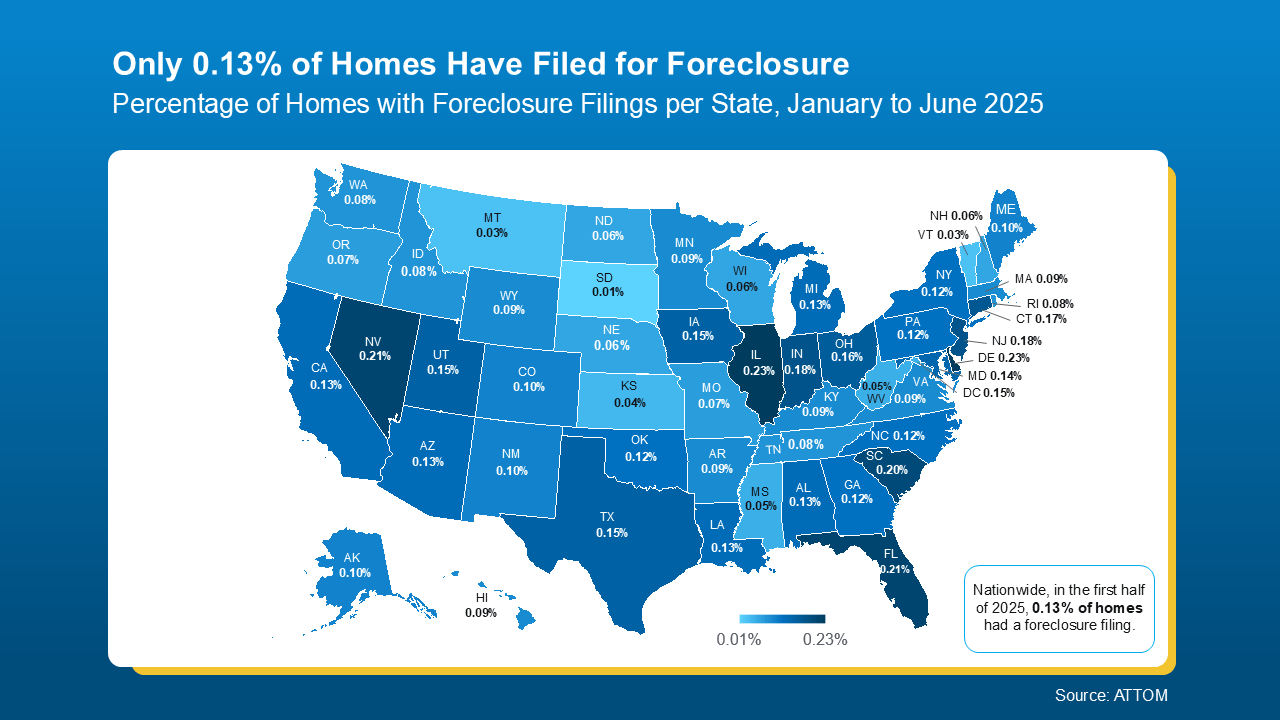
For context, data from ATTOM shows in the first half of 2025, 1 in every 758 homes nationwide had a foreclosure filing. Thats the 0.13% you can see in the map above. But in 2010, back during the crash? Mortgage News Daily says it was 1 in every 45 homes.


Today’s Numbers Don’t Indicate a Market in Trouble

But here’s what everyone remembers…

Leading up to the crash, risky lending practices left homeowners with payments they eventually couldn’t afford. That led to a situation where many homeowners were underwater on their mortgages. When they couldn’t make their payments, they had no choice but to walk away. Foreclosures surged, and the market ultimately crashed.

Today’s housing market is very different. Lending standards are stronger. Homeowners have near record levels of equity. And when someone hits financial trouble, that equity means many people can sell their home rather than face foreclosure. As Rick Sharga, Founder of CJ Patrick Company, explains:

“. . . a significant factor contributing to today’s comparatively low levels of foreclosure activity is that homeowners—including those in foreclosure—possess an unprecedented amount of home equity.”

No one wants to see a homeowner struggle. But if you’re a homeowner facing hardship, talk to your mortgage provider. You may have more options than you think.
 

Bottom Line

Recent headlines may not tell the whole story, but the data does. Foreclosure activity remains low by historical standards and is not a sign of another crash.

If you’re simply watching the market and want to understand what’s really going on, or how this impacts the value of your home, let’s connect. I’ll help you separate fact from fear by showing you what the data really says.


Don’t Make These Mistakes When Selling Your House

(Published on - 7/21/2025 11:43:00 AM)

Don’t Make These Mistakes When Selling Your House


Are you thinking about selling your house? Some common mistakes today can make the process more stressful or even cost you money.

Fortunately, they’re easy to avoid, as long as you know what to watch for.Let’s break down the biggest seller slip-ups, and how an agent helps you steer clear of them.


1. Overpricing Your House

It’s completely natural to want top dollar for your house, especially if you’ve put a lot of work into it. But in today’s shifting market, pricing it too high can backfire. Investopedia explains:

“Setting a list price too high could mean your home struggles to attract buyers and stays on the market for longer.

And your house sitting on the market for a long time could lead to price cuts that raise red flags. That’s why pricing your house right from the start matters.

A great real estate agent will look at what other homes nearby have sold for, the condition of your house, and what’s happening in your market right now. That helps them find a price that’s more likely to bring in buyers, and maybe even more than one offer.


2. Spending Money on the Wrong Upgrades

The housing market has nearly a half million more sellers than buyers according to Redfin. That means you have more competition as a seller and may have to do a bit more to get your house ready to sell. But not all projects are going to be worth it. If you spend money on the wrong projects, it could really cut into your profit.

A local real estate pro knows what buyers in your area are really looking for, and they can help you figure out which projects are worth it, and which ones to skip. Even better, they’ll know how to highlight any upgrades you make in your listing, so your house stands out online and gets more attention.


3. Refusing To Negotiate

Now that inventory has grown, it’s important to stay flexible. Buyers have more options – and with it comes more negotiating power. U.S. News explains:

“If you’ve received an offer for your house that isn’t quite what you’d hoped it would be, expect to negotiate . . . make sure the buyer also feels like he or she benefits . . . consider offering to cover some of the buyer’s closing costs or agree to a credit for a minor repair the inspector found.”

That’s where your agent comes in. They’ll help you understand what buyers are asking for, what’s normal in today’s market, and how to find a win-win solution. Sometimes making a small compromise can keep the deal moving and help you move on to your next chapter faster.


4. Skipping Research When Hiring an Agent

All of these mistakes are avoidable with the help of a skilled agent. So, you want to be sure you're working with the right partner. Still, according to the National Association of Realtors (NAR), 81% of sellers pick the first agent they talk to.

Many homeowners may skip basic steps like reading reviews, checking sales history, and interviewing a few agents. But that’s a mistake. You want someone you know you can rely on – someone with a good track record. The right agent can help you price your house right, market it well, and sell it quickly (and maybe for more money).


Bottom Line

Selling a house doesn’t have to be stressful, especially if you have an experienced agent by your side. Let’s connect so you have an expert to help you avoid these common mistakes and make the most of your sale.

What’s one thing you’d want expert advice on before putting your house on the market?


Why a Newly Built Home Might Be the Move Right Now

(Published on - 7/17/2025 11:43:40 AM)

Why a Newly Built Home Might Be the Move Right Now


Are you looking for better home prices, or even a lower mortgage rate? You might find both in one place: a newly built home. While many buyers are overlooking new construction, it could be your best opportunity in today’s market. Here’s why.

There are more brand-new homes available right now than there were even just a few months ago. According to the most recent data from the Census and the National Association of Realtors (NAR), roughly 1 in 5 homes for sale right now is new construction. So, if you’re not looking at newly built homes, you’re missing out on a big portion of what’s available.

And with more new homes on the market, builders are motivated to sell their current inventory. As a result, many are taking steps to draw in buyers.


Builders Are Cutting Prices

According to Buddy Hughes, Chairman of the National Association of Home Builders (NAHB):

“Almost 40% of home builders reduced sales prices in the last month . . .”

That means builders are being realistic about today’s market and adjusting to what buyers can afford. It’s their way to keep their inventory moving.

So, builders may be more willing to negotiate price than you’d expect – and that means your dollar may go further if you buy a newly built home. Lean on your agent to see what’s available and what incentives builders are offering in and around your area.


Builders Are Offering Lower Mortgage Rates

Here’s something most people don’t know. Right now, buyers of brand-new homes often get better mortgage rates than buyers of existing homes.

That’s because many builders are also offering rate buydowns to make their homes more attractive and keep sales moving. Basically, they’re willing to chip in to lower your rate, so you’re more likely to buy one of their homes.

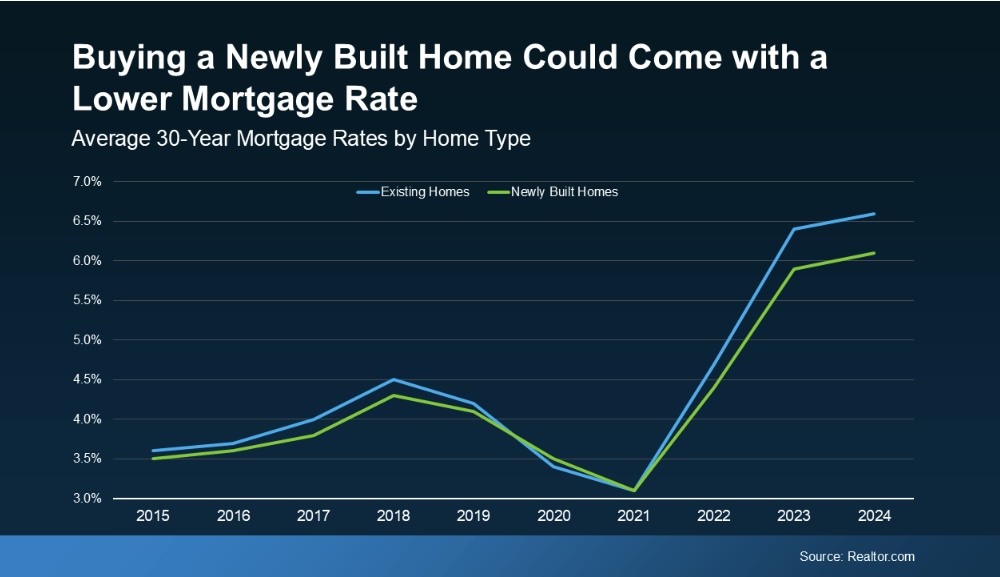
Data from Realtor.com shows, in 2023 and 2024, buyers of newly built homes got a mortgage rate around half a percent lower compared to those who bought existing homes (see graph below):

That kind of savings adds up and makes a big difference when you’re figuring out your monthly budget.

So, if you haven’t found something you love yet, it’s time to add newly built homes to your search. You may find that what you’ve been looking for is already out there, it’s just in a new home community.


Bottom Line

More choices, the potential to negotiate on the price, and maybe even better mortgage rates make these options a bright spot in today’s housing market.

If you haven’t considered a newly built home yet, what’s holding you back?

Let’s talk about it and see if it’s worth checking out new builds in and around our area.


Mortgage Rates Are Stabilizing – How That Helps Today’s Buyers

(Published on - 7/16/2025 11:56:34 AM)

Mortgage Rates Are Stabilizing – How That Helps Today’s Buyers


Over the past few years, affordability has been the biggest challenge for homebuyers. Between rapidly rising home prices and higher mortgage rates, many have felt stuck between a rock and a hard place.

But, something pretty encouraging is happening. While affordability is still tight, mortgage rates have shown signs of stabilizing in recent months. And that may finally make it a bit easier to plan your move.


Mortgage Rates Have Stabilized – For Now

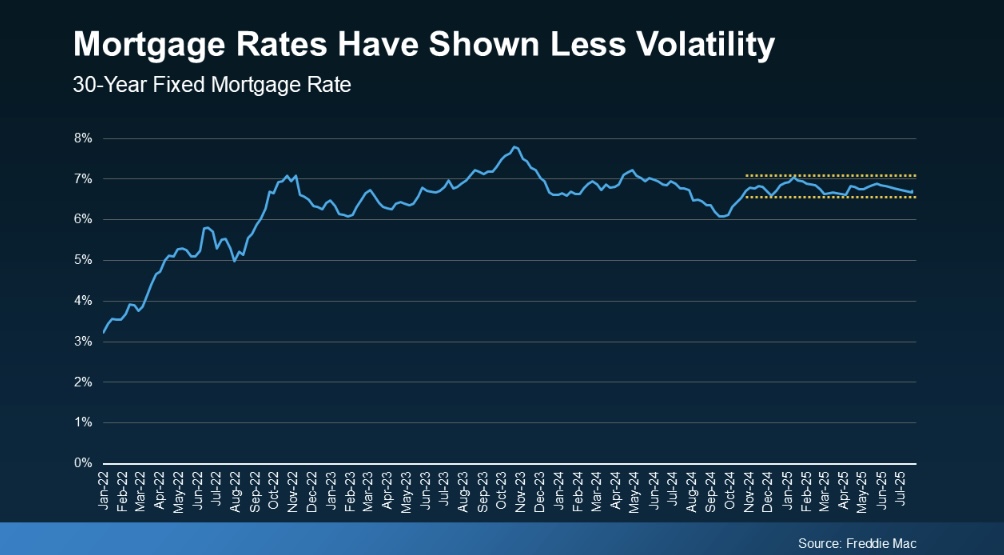
Over the past year, mortgage rates have had their share of ups and downs, making it tough for buyers to know what to expect. But recently, rates have started to level out and have settled into a more narrow range (see graph below):

As the graph shows, rates have stayed within that half-percentage-point since late last year. Yes, there’s been movement within that range, but wild swings and sudden ups and downs just haven’t been the story lately. And that’s a bigger deal than you may realize. As HousingWire explains:

“Analysts, economists and mortgage professionals are coining this quarter’s activity as one of the most “calm” periods for mortgage rates in recent memory.”

How This Helps Today’s Buyers

Let’s be real. Unpredictability makes it tough to plan ahead. When rates are bouncing around and making big jumps week to week, it’s easy to be intimidated. But with rates staying in a pretty steady range over the past several months, you have a clearer picture of what your potential monthly payment could look like. That makes moving feel less uncertain – and more doable.

So, stop waiting. And start planning. Even though rates may not be where you want them to be right now, they have been much less volatile for quite some time.


Will This Stability Last?

According to the experts, it looks like that stability might hang around for a bit. Rates may come down ever so slightly in the months ahead, but it’ll likely be a slow and mild change. As Danielle Hale, Chief Economist at Realtor.com, says:

“I expect a generally downward trend for rates this year, but at a slow enough pace that it might not be noticeable in any given month.”

So, if you’ve been holding out for the perfect mortgage rate, the best advice is to avoid trying to time the market. It may not look terribly different than the opportunity you already have in front of you. As Jeff Ostrowski, Housing Market Analyst at Bankrate, explains:

“Trying to time mortgage rates is really difficult. There’s no guarantee that rates are going to be any more favorable in three months or six months.”

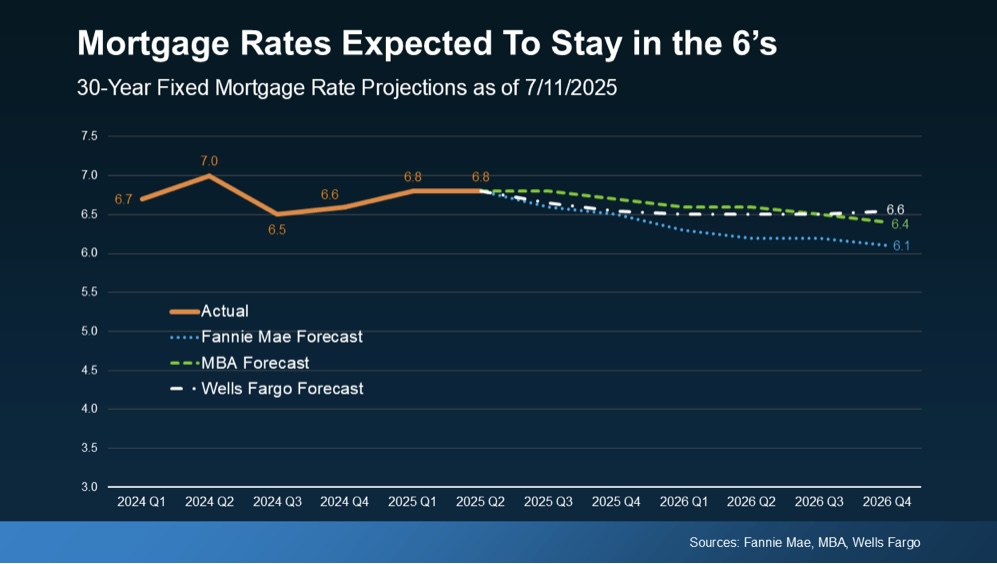
And if we look at the latest expert forecasts that go out a bit further, even those tell much of the same story. Two out of the three projections say rates will still likely be in the mid-6% range by the end of 2026 (see graph below):

This puts today’s buyers in a much better spot. As Sam Khater, Chief Economist at Freddie Mac, explains:

“Mortgage rates have moved within a narrow range for the past few months . . . Rate stability, improving inventory and slower house price growth are an encouraging combination . . .”

Just remember, mortgage rates are still going to react to changing economic conditions, inflation, and more – and that means they could shift again. But right now, you’ve got more predictability, and that means more opportunity, too. 

Bottom Line

While affordability is still a challenge, the market may be offering a bit more stability – and that makes planning your next move a lot easier.

Let’s connect if you want to run the numbers and see what a monthly payment would look like in today’s market. That way you can stop waiting and start planning.


The Advice First-Time Homebuyers Need To Hear

(Published on - 7/14/2025 12:02:58 PM)

The Advice First-Time Homebuyers Need To Hear


Buying your first home is a big milestone – and the right support is going to make it a whole lot easier.

Because while this process might be brand new to you, it’s not new to your agent. They’ve helped plenty of first-time buyers through it. They know what works, what actually matters, and how you can move through the process with a lot less guesswork.

Here are a few real-world tips based on that experience of helping other first-time buyers.

Tip #1: Get Pre-Approved First

Rocket Mortgage says this is one of the most common mistakes first-time buyers make. And it’s easy to see why. Looking at homes online is fun. But doing it before you know your numbers? That’s risky. You don’t want to fall in love with a house that’s way outside of your financial comfort zone. That's a fast track for getting frustrated.

Instead, find your agent and talk to a lender early – before looking at any houses. With your lender’s help, you’ll be able to get pre-approved for your home loan. That’ll give you a better idea of what you’ll be able to borrow. And it helps you set a realistic budget. Then, your agent will be able to make you a customized list of homes, so you’re only seeing what’ll work for what you can spend. More clarity, less frustration.

Tip #2: Set a Budget and Stick To It

Remember, just because you can borrow up to a certain amount, chances are you won’t want to max that number out. It’s really important to avoid overextending your budget, especially in today’s market. Other housing expenses like home insurance, homeowners association (HOA) fees, and taxes are on the rise, and you need to factor those in. Bankrate offers this advice:

“When you’re building a budget to narrow your search for properties, don’t just think about how much house you can afford, but how much in recurring costs you can handle once you’ve purchased your home.”

So, lean on the pros for advice on expenses you may not be thinking of, so you can work them into your budget. 

Tip #3: Don't Skip the Inspection 

When you find the right home, it’s easy to get caught up in the excitement. But skipping the inspection just to make your offer look stronger is a gamble that could cost you.

Instead, work with your agent to schedule a real inspection. They'll connect you with local pros, make sure it’s booked, and help you understand the results so you can negotiate repairs or ask for money off at closing, if needed. It’s better to invest in this time up front to avoid what could be thousands in surprise repairs later.

Tip #4: Your First Home Doesn’t Have To Be Your Forever Home

For a lot of buyers, this is where unnecessary pressure creeps in. But remember, you don't have to land your dream home right out of the gate. That’s why it’s called a starter home. It's a starting point, not your final destination.

An agent will help you explore all your options, including ones you may not have thought about. For example, a well-kept condo, a townhouse in a great location, or a house with good bones can be a perfect first step into homeownership. The goal? Get in. Start building equity. Then, grow from there.


Bottom Line

Buying your first place is a big step, but it doesn’t have to feel like a step in the dark. Let’s talk about where you’re starting, what’s stressing you out (or holding you back), and what you actually need to know to make it happen.

What’s one question you wish you could ask an expert right now?


Posts

;

Questions? Need Advice? Complete this form for more information.

Contact Information::


Copyright 2025 Realty Executives All Rights Reserved

Regional Branch Manager

Nicole Monahan

Contact
Disclaimer: Each office independently owned and operated. Please disregard this message if you are already under contract with another real estate professional.