Mark Sotir
Broker
Realty Executives Midwest
Nestled in the heart of DuPage County, Clarendon Hills, Illinois offers a charming community with a thriving real estate market. Whether you're a prospective buyer, seller, or simply curious about local property trends, this blog post will provide you with an overview of the current state of the Clarendon Hills real estate market.
Average Home Prices and Market Time:
As of the latest data, the average home price in Clarendon Hills stands at an attractive $553,500. This figure indicates the value and desirability of the town's real estate offerings, reflecting the area's appeal to homeowners seeking a comfortable suburban lifestyle with easy access to urban amenities.
Furthermore, Clarendon Hills boasts a relatively quick market time, with homes typically spending an average of 51 days on the market. Although this figure represents a 30.8% increase in market time compared to the previous period, it remains relatively low, indicating a continued demand for homes in the area.
Reduced Inventory:
One notable trend in the Clarendon Hills real estate market is a decline in the number of homes available for sale. Currently, the inventory is down by 20.6%, suggesting a limited supply of properties on the market. This reduced inventory has likely contributed to the overall demand and competition among buyers, as potential homeowners vie for the available homes in this sought-after community.
Connect with Mark Sotir for More Insights:
For a comprehensive understanding of the Clarendon Hills real estate market and personalized assistance, you can reach out to me at Realty Executives Midwest. With his extensive knowledge and experience in the local market, I can provide you with valuable insights, up-to-date statistics, and guidance tailored to your specific needs.
To get in touch with me, you can reach me at 630-815-8098 or via email at marksotir@realtyexecutives.com.
If you're considering buying or selling a property in Clarendon Hills or simply want to stay informed about the latest real estate trends, Mark Sotir from Realty Executives Midwest is your go-to expert. Reach out to Mark to receive personalized advice and gain a deeper understanding of the local market conditions.
With its attractive homes, community amenities, and proximity to the city, Clarendon Hills continues to be a desirable location for those seeking a comfortable suburban lifestyle.

.
Nestled in the heart of DuPage County, Clarendon Hills, Illinois offers a charming community with a thriving real estate market. Whether you're a prospective buyer, seller, or simply curious about local property trends, this blog post will provide you with an overview of the current state of the Clarendon Hills real estate market.
Average Home Prices and Market Time:
As of the latest data, the average home price in Clarendon Hills stands at an attractive $553,500. This figure indicates the value and desirability of the town's real estate offerings, reflecting the area's appeal to homeowners seeking a comfortable suburban lifestyle with easy access to urban amenities.
Furthermore, Clarendon Hills boasts a relatively quick market time, with homes typically spending an average of 51 days on the market. Although this figure represents a 30.8% increase in market time compared to the previous period, it remains relatively low, indicating a continued demand for homes in the area.
Reduced Inventory:
One notable trend in the Clarendon Hills real estate market is a decline in the number of homes available for sale. Currently, the inventory is down by 20.6%, suggesting a limited supply of properties on the market. This reduced inventory has likely contributed to the overall demand and competition among buyers, as potential homeowners vie for the available homes in this sought-after community.
Connect with Mark Sotir for More Insights:
For a comprehensive understanding of the Clarendon Hills real estate market and personalized assistance, you can reach out to me at Realty Executives Midwest. With his extensive knowledge and experience in the local market, I can provide you with valuable insights, up-to-date statistics, and guidance tailored to your specific needs.
To get in touch with me, you can reach me at 630-815-8098 or via email at marksotir@realtyexecutives.com.
If you're considering buying or selling a property in Clarendon Hills or simply want to stay informed about the latest real estate trends, Mark Sotir from Realty Executives Midwest is your go-to expert. Reach out to Mark to receive personalized advice and gain a deeper understanding of the local market conditions.
With its attractive homes, community amenities, and proximity to the city, Clarendon Hills continues to be a desirable location for those seeking a comfortable suburban lifestyle.


The National Association of Realtors (NAR) will release its latest Existing Home Sales (EHS) report later this week. This monthly report provides information on the sales volume and price trend for previously owned homes. In the upcoming release, it’ll likely say home prices are down. This may feel a bit confusing, especially if you’ve been following along and seeing the blogs saying that home prices have bottomed out and turned a corner.
So, why will this likely say home prices are falling when so many other price reports say they’re going back up? It all depends on the methodology of each report. NAR reports on the median sales price, while some other sources use repeat sales prices. Here’s how those approaches differ.
The Center for Real Estate Studies at Wichita State University explains median prices like this:
“The median sale price measures the ‘middle’ price of homes that sold, meaning that half of the homes sold for a higher price and half sold for less . . . For example, if more lower-priced homes have sold recently, the median sale price would decline (because the “middle” home is now a lower-priced home), even if the value of each individual home is rising.”
Investopedia helps define what a repeat sales approach means:
“Repeat-sales methods calculate changes in home prices based on sales of the same property, thereby avoiding the problem of trying to account for price differences in homes with varying characteristics.”
As the quotes above say, the approaches can tell different stories. That’s why median price data (like EHS) may say prices are down, even though the vast majority of the repeat sales reports show prices are appreciating again.
Bill McBride, Author of the Calculated Risk blog, sums the difference up like this:
“Median prices are distorted by the mix and repeat sales indexes like Case-Shiller and FHFA are probably better for measuring prices.”
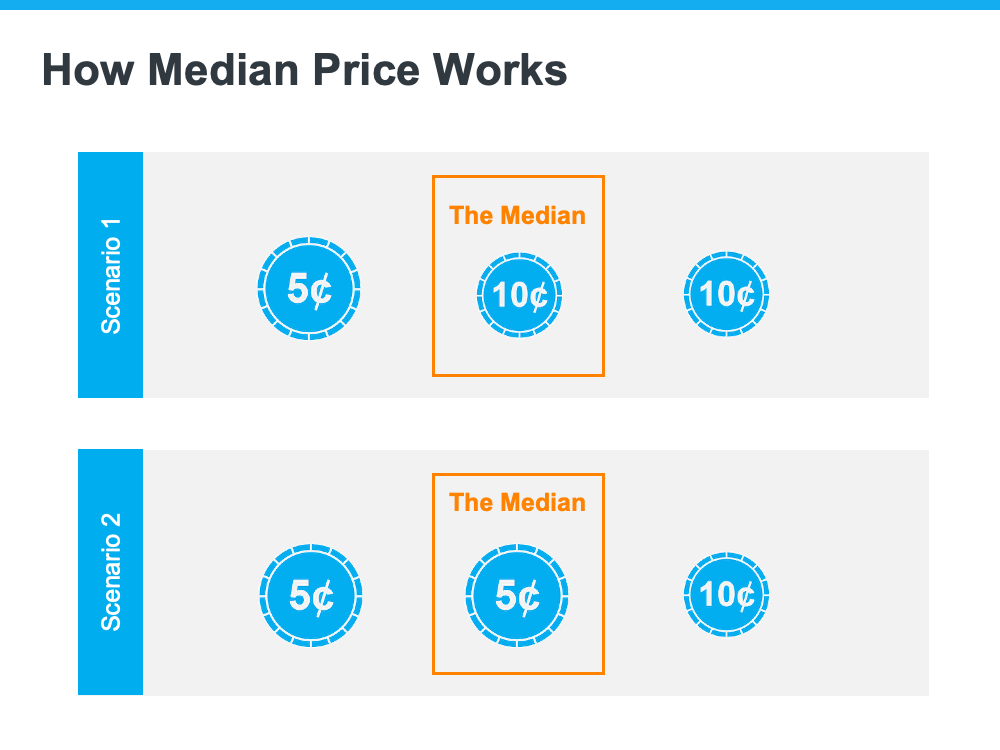
To drive this point home, here’s a simple explanation of median value (see visual below). Let’s say you have three coins in your pocket, and you decide to line them up according to their value from low to high. If you have one nickel and two dimes, the median value (the middle one) is 10 cents. If you have two nickels and one dime, the median value is now five cents.
In both cases, a nickel is still worth five cents and a dime is still worth 10 cents. The value of each coin didn’t change.
That’s why using the median home price as a gauge of what’s happening with home values isn’t worthwhile right now. Most buyers look at home prices as a starting point to determine if they match their budgets. But, most people buy homes based on the monthly mortgage payment they can afford, not just the price of the house. When mortgage rates are higher, you may have to buy a less expensive home to keep your monthly housing expense affordable. A greater number of ‘less-expensive’ houses are selling right now for this exact reason, and that’s causing the median price to decline. But that doesn’t mean any single house lost value.
When you see the stories in the media that prices are falling later this week, remember the coins. Just because the median price changes, it doesn’t mean home prices are falling. What it means is the mix of homes being sold is being impacted by affordability and current mortgage rates.
For a more in-depth understanding of home price trends and reports, let’s connect.

If you're planning to buy your first home, then you're probably focused on saving for all the costs involved in such a big purchase. One of the expenses that may be at the top of your mind is your down payment. If you’re intimidated by how much you need to save for that, it may be because you believe you must put 20% down. That doesn’t necessarily have to be the case. As the National Association of Realtors (NAR) notes:
“One of the biggest misconceptions among housing consumers is what the typical down payment is and what amount is needed to enter homeownership.”
And a recent Freddie Mac survey finds:
“. . . nearly a third of prospective homebuyers think they need a down payment of 20% or more to buy a home. This myth remains one of the largest perceived barriers to achieving homeownership.”
Here’s the good news. Unless specified by your loan type or lender, it’s typically not required to put 20% down. This means you could be closer to your homebuying dream than you realize.
According to NAR, the median down payment hasn’t been over 20% since 2005. In fact, the median down payment for all homebuyers today is only 14%. And it’s even lower for first-time homebuyers at just 6% (see graph below):
What does this mean for you? It means you may not need to save as much as you originally thought.
And it’s not just how much you need for your down payment that isn’t clear. There are also misconceptions about down payment assistance programs. For starters, many people believe there’s only assistance available for first-time homebuyers. While first-time buyers have many options to explore, repeat buyers have some, too.
According to Down Payment Resource, there are over 2,000 homebuyer assistance programs in the U.S., and the majority are intended to help with down payments. That same resource goes on to say:
“You don’t have to be a first-time buyer. Over 38% of all programs are for repeat homebuyers who have owned a home in the last 3 years.”
Plus, there are even loan types, like FHA loans with down payments as low as 3.5% as well as options like VA loans and USDA loans with no down payment requirements for qualified applicants.
If you’re interested in learning more about down payment assistance programs, information is available through sites like Down Payment Resource. Then, partner with a trusted lender to learn what you qualify for on your homebuying journey.
Remember, a 20% down payment isn’t always required. If you want to purchase a home this year, let’s connect to start the conversation about your homebuying goals.

If you're thinking about buying or selling a house, it's important to know that it doesn't just affect your life, but also your community.
The National Association of Realtors (NAR) releases a report every year to show how much economic activity is generated by home sales. The chart below illustrates that impact:
As the visual shows, when a house is sold, it can make a big difference in the local economy. The impact comes largely from the workers required to build, update, and buy and sell homes. Robert Dietz, Chief Economist at the National Association of Home Builders (NAHB), explains how the housing industry adds jobs to a community:
“The economic impact means housing is a significant job creator. In fact, for every single-family home built, enough economic activity is generated to sustain three full-time jobs for a year, per NAHB research. . . . And one job for every $100,000 in remodeling spending.”
Housing being a major job creator makes sense when you consider there are many different industries involved in the process. A recent article from Fortune notes housing activity could have a more robust impact than you think due to the many ways it’s tied to the economy:
“Housing has three direct linkages to economic activity (GDP): the construction of new homes, the remodeling of existing homes, and that of housing transactions. . . . consider the activity associated with home sales – think broker fees, lawyers, etc. – which are a sizable contributor to housing’s GDP footprint.”
When you buy or sell a home, you work with a team of professionals, including contractors, specialists, lawyers, and city officials. Each person plays a role in making the transaction happen.
So, when you make a move in the housing market, you're not just meeting your own needs, you're also making a positive impact on the community. Knowing this can give you a sense of empowerment as you make your decision this year.
Each and every home sale is important for the local economy. If you’re ready to move, let’s connect. It won’t just change your life – it’ll also have a strong positive effect on the whole community.