Mark Sotir
Broker
Realty Executives Midwest

From the opportunity to take advantage of today’s low mortgage rates to changing homeowner needs, Americans have more motivation than ever to buy a home. According to the experts, buyers are making moves right now, creating an unseasonably strong housing market for this time of year.
As we wrap up the fall season and move into the winter months, here’s a look at what several industry leaders have to say about the continued momentum in the current market, and what it means as we head into the early part of next year.
“This solid buying is a testament to demand still being relatively high, as it is occurring during a time when inventory is still markedly low. The notable gain in October assures that total existing-home sales in 2021 will exceed 6 million, which will shape up to be the best performance in 15 years.”
“So far in November, purchase applications point to another strong month in sales. Still low rates and demographic demand support this strength, even as affordability and inventory headwinds remain.”
“The demand for housing in the United States has reached a fever pitch, a trend that opposes the norm of this time of the year when the market cools as the winter months set in.”
“Strong demographic demand will continue to act as the wind in the housing market’s sails.”
Buyers are actively in the market, and they’re competing for homes to purchase. With the momentum coming out of this fall, all signs point to the winter housing market picking up steam, making it much busier than in a more typical year. And as we’ve seen in so many ways, 2020 and 2021 were anything but typical in real estate. It looks like 2022 may be joining that list before we know it.
If you think the housing market will slow down this winter, think again. Whether you’re thinking of buying a home, selling your house, or both – let’s connect to determine if this winter is your best time to make a move too.
![A Happy Tail: Pets and the Homebuying Process [INFOGRAPHIC] | MyKCM](https://files.mykcm.com/2021/12/08135318/20211210-MEM-1046x1910.png)

If you’re a homeowner who’s decided your current house no longer fits your needs, or a renter with a strong desire to become a homeowner, you may be hoping that waiting until next year could mean better market conditions to purchase a home.
To determine whether you should buy now or wait another year, you can ask yourself two simple questions:
Let’s shed some light on the answers to both of these questions.
Three major housing industry entities are projecting ongoing home price appreciation in 2022. Here are their forecasts:
According to the National Association of Realtors (NAR), the median price of a home today is $353,900. Using an average of the three price projections above (6.53%), a home that sold for $353,900 today would be valued at $377,010 at the end of next year. As a prospective buyer, you would therefore pay an additional $23,110 by waiting.
Today, Freddie Mac estimates the average 30-year fixed mortgage rate in the fourth quarter of this year will be 2.8%. However, most experts believe mortgage rates will rise as the economy recovers. Here are the forecasts for the fourth quarter of 2022 by the three major entities mentioned above:
That averages out to 3.73% if you include all three forecasts. Any increase in mortgage rates will increase your costs.
If both variables increase, you’ll pay a lot more in mortgage payments each month. Let’s assume you purchase a $353,900 home in the fourth quarter of this year with a 30-year fixed-rate loan at 2.8% after making a 10% down payment. According to mortgagecalculator.net, your monthly mortgage payment would be approximately $1,309 (this does not include insurance, taxes, and other fees because those vary by location).
That same home one year from now could cost $377,010, and the mortgage rate could be 3.73% (based on the industry forecasts mentioned above). Your monthly mortgage payment after putting down 10%, would be approximately $1,568.
The difference in your monthly mortgage payment would be $259. That’s $3,108 more per year and $93,240 over the life of the loan.
Add to that the approximately $23,110 a house with a similar value would build in home equity this year due to home price appreciation, and the total net worth increase you could gain by buying this year is over $115,000 (the $93,240 mortgage savings plus the $23,110 potential gain in equity if you buy now).
When asking if you should buy a home, you may think of the non-financial benefits of homeownership. When asking when to buy, the financial benefits make it clear that doing so now is much more advantageous than waiting until next year.

Since the pandemic began, Americans have reevaluated the meaning of the word home. That’s led some renters to realize the many benefits of homeownership, including the feelings of security and stability and the financial benefits that come with rising home equity. At the same time, many current homeowners have decided their house no longer meets their needs, so they moved into homes with more space inside and out, including a home office for remote work.
However, not every purchaser has been able to fulfill their desire for a new home. Here are two obstacles some homebuyers are facing:
This past week, both of those challenges have been mitigated to some degree for many purchasers. The FHFA (which handles mortgages by Freddie Mac, Fannie Mae, and the Federal Housing Administration) is raising its loan limit for prospective purchasers in 2022. The term used to describe the maximum loan amount they will entertain is the Conforming Loan Limit.
Investopedia explains the difference in a recent post:
“Conforming loans are the only loans that meet the requirements to be acquired by Fannie Mae and Freddie Mac. Jumbo loans, which exceed the conforming limit, are the most common type of nonconforming loan.”
A Forbes article earlier this year explains the benefits of a conforming loan and why they exist:
“Since lenders can’t sell non-conforming loans to Fannie Mae or Freddie Mac to free up their cash, they’re a bit riskier for the lender. This is especially true for jumbo loans, which aren’t backed by any government guarantees. If you default on a jumbo loan, it’s a huge blow to the lender.
Thus, lenders generally charge higher interest rates to compensate, and they can have even more requirements. For example, lenders who give out jumbo loans often require that you make a down payment of at least 20% and show that you have at least six months’ worth of cash in reserve, if not more.”
The FHFA has significantly increased its Conforming Loan Limits for 2022. Sandra L. Thompson, FHFA Acting Director, explains in the press release that:
“Compared to previous years, the 2022 Conforming Loan Limits represent a significant increase due to the historic house price appreciation over the last year. While 95 percent of U.S. countie?s will be subject to the new baseline limit of $647,200, approximately 100 counties will have conforming loan limits approaching $1 million.”
This means that more homes now qualify for a conforming loan with lower down payment requirements and easier lending standards – the two challenges holding many buyers back over the last year.
The Federal Housing Administration (FHA) also increased its Conforming Loan Limits for 2022. That could also mean an easier path to homeownership for many prospective buyers. As the Forbes article explains:
“FHA loans can be very beneficial if you don’t have as much savings, or if your credit score could use some work.”
Buying your first or your next home may have just gotten much easier (less stringent qualifying standards) and less expensive (possibly lower mortgage rate). Let’s connect to discuss how these changes may impact you.

If you’re trying to decide when to sell your house, there may not be a better time than this winter. Selling this season means you can take advantage of today’s strong sellers’ market when you make a move.
Right now, conditions are very favorable for current homeowners looking for a change. If you sell now, here’s what you can expect:
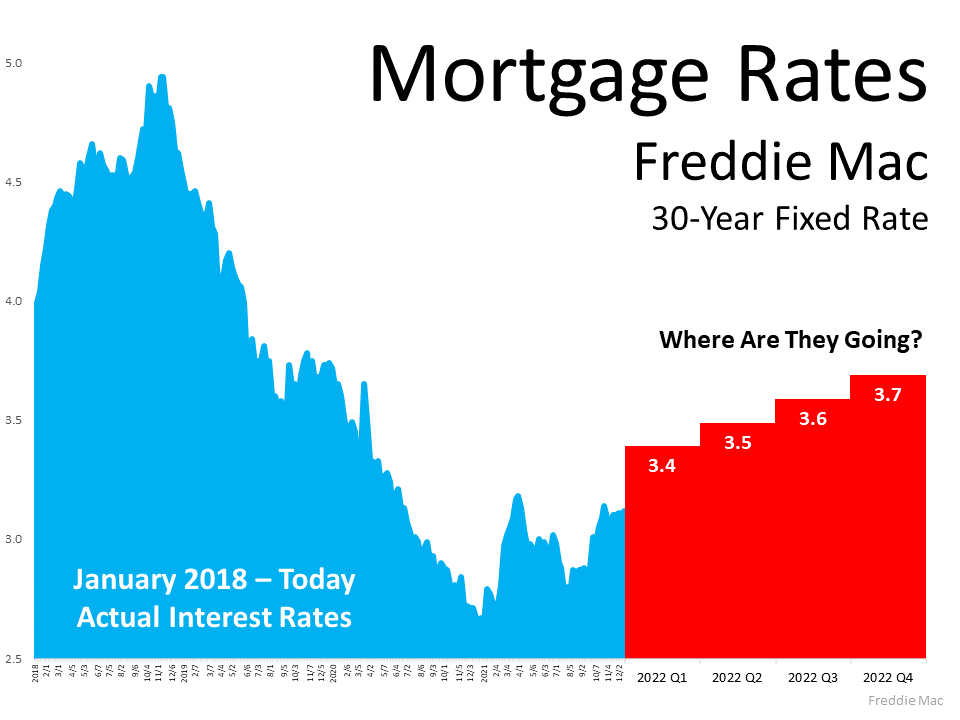
In addition to these great perks, you’ll also win big on your next move if you sell now. CoreLogic reports homeowners gained an average of $51,500 in equity over the past year. This wealth boost is the result of buyer competition driving home prices up. You can leverage that equity to fuel a move, before mortgage rates and home prices climb higher. To get a feel for how rates are projected to rise, see the chart below.
The longer you wait to make your move, the more it will cost you down the road. As mortgage rates rise, even modestly, it will impact your monthly payment when you purchase your next home. Waiting just a few months to make that change could mean a long-term financial impact.
The good news is today’s rates are still hovering in a historically low range. According to Doug Duncan, Senior VP and Chief Economist at Fannie Mae:
“Right now, we forecast mortgage rates to average 3.3 percent in 2022, which, though slightly higher than 2020 and 2021, by historical standards remains extremely low . . .”
Selling before rates climb higher means you can make your move and lock in a low rate on the mortgage for your next home. This helps you get more home for your money and keeps your payments down too.
As a homeowner, you have a great opportunity to get the best of both worlds this season. You can truly win when you sell and when you buy. If you’re thinking about making a move, let's connect so you have the information you need to get the process started.